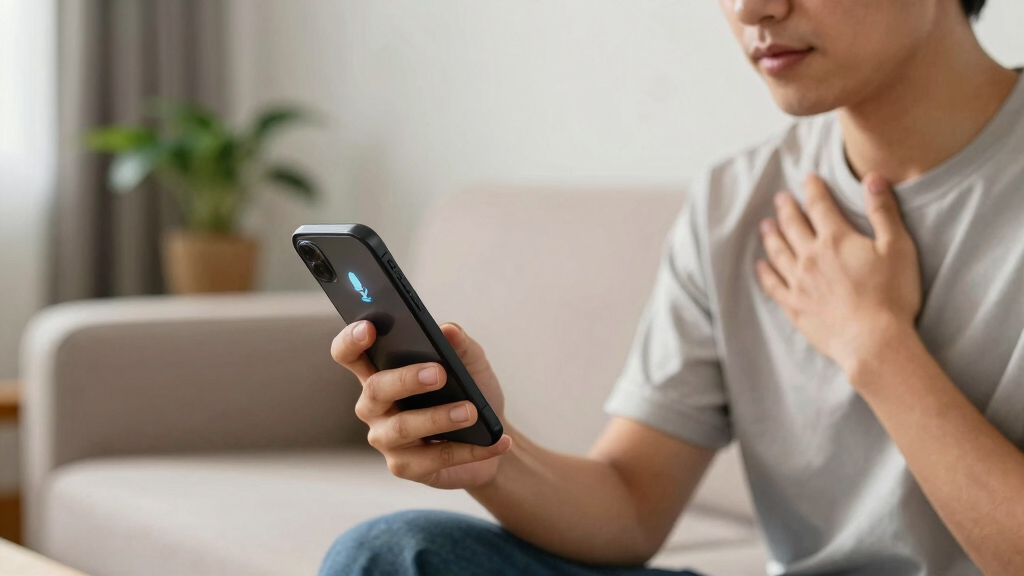

TL;DR
A developer has created a phone app that detects and reflects breathing patterns in real time using only the device’s microphone. It aims to enhance self-awareness without wearables or speech recognition. Validation studies are ongoing to assess accuracy in uncontrolled environments.
A new app showcases real-time breath detection and biofeedback using only a smartphone microphone, without uploading audio or recognizing speech. This development matters because it aims to offer a simple, privacy-conscious tool for self-awareness and mindfulness, potentially transforming how people engage with breathing exercises on mobile devices.
The app processes audio locally on the device, analyzing the envelope and spectral features of breathing sounds to determine inhale, exhale, and transition phases. It employs a layered approach: signal processing, a phase-tracking state machine, and quality checks to handle real-world audio quirks. The system does not recognize speech or transcribe audio; it solely focuses on breathing patterns. Developers acknowledge that microphone-only breath detection in uncontrolled environments remains challenging, and validation studies are underway to measure its accuracy against clinical benchmarks. The app can provide real-time feedback, enabling users to observe their breathing rhythm and stability without distractions or wearables.
Why It Matters
This development is significant because it offers a privacy-preserving, hardware-light method for self-awareness and mindfulness practices. If validated, it could make breath-based biofeedback more accessible and less intrusive, potentially influencing wellness app design and personal health monitoring. It also raises questions about the limits of smartphone sensors for physiological measurements in uncontrolled settings.
smartphone microphone breath detection app
As an affiliate, we earn on qualifying purchases.
As an affiliate, we earn on qualifying purchases.
Background
Previous breath detection systems often relied on wearables or controlled environments, with smartphone-based methods lagging behind in accuracy. This project builds on ongoing research into mobile audio analysis, emphasizing local processing and privacy. The developer’s approach reflects a broader trend toward accessible, user-friendly wellness tools that do not compromise data security. Validation efforts are part of a growing field exploring the potential of smartphones for health-related sensing.
“Most ‘mindfulness’ software ends up competing for attention rather than handing it back. We wanted to know whether the phone could do the opposite: stay quiet, listen to how you breathe, and reflect it back closely enough that you notice your own pattern.”
— the developer
“Microphone-only breath detection in uncontrolled conditions is genuinely hard, and published smartphone-only systems sit well below wearable-based ones. We are running a validation study against clinical ground truth to find out how good this actually is.”
— the developer
biofeedback breathing app for mindfulness
As an affiliate, we earn on qualifying purchases.
As an affiliate, we earn on qualifying purchases.
What Remains Unclear
It is not yet clear how accurate the breath detection system will be across diverse environments and devices. Validation results are pending, and the system’s robustness in real-world conditions remains to be confirmed.
mobile breathing pattern monitor
As an affiliate, we earn on qualifying purchases.
As an affiliate, we earn on qualifying purchases.
What’s Next
The developers plan to publish validation results from ongoing studies, refine the detection algorithms, and potentially integrate personalized breathing guidance based on detected patterns. Further testing will determine the app’s reliability and usability in everyday settings.
privacy-focused breathing sensor
As an affiliate, we earn on qualifying purchases.
As an affiliate, we earn on qualifying purchases.
Key Questions
Does the app upload or analyze my speech or audio data?
No. The microphone stream is processed locally on the device, and raw audio does not leave the phone. The system analyzes breathing sounds, not speech, and only quality-checked data is stored locally for model improvement.
Do I need an account to try the app?
Users can try the browser biofeedback demo without creating an account. The native app requires an account for features like saved sessions and personalized feedback.
How accurate is this breath detection system?
Accuracy is still being validated through ongoing studies comparing the app’s detection to clinical ground truth. Its performance in uncontrolled environments is not yet fully established.
Can this app diagnose or treat health conditions?
No. The app is a wellness and self-awareness tool, not a medical device. It does not diagnose or treat any health issues.
Source: Hacker News