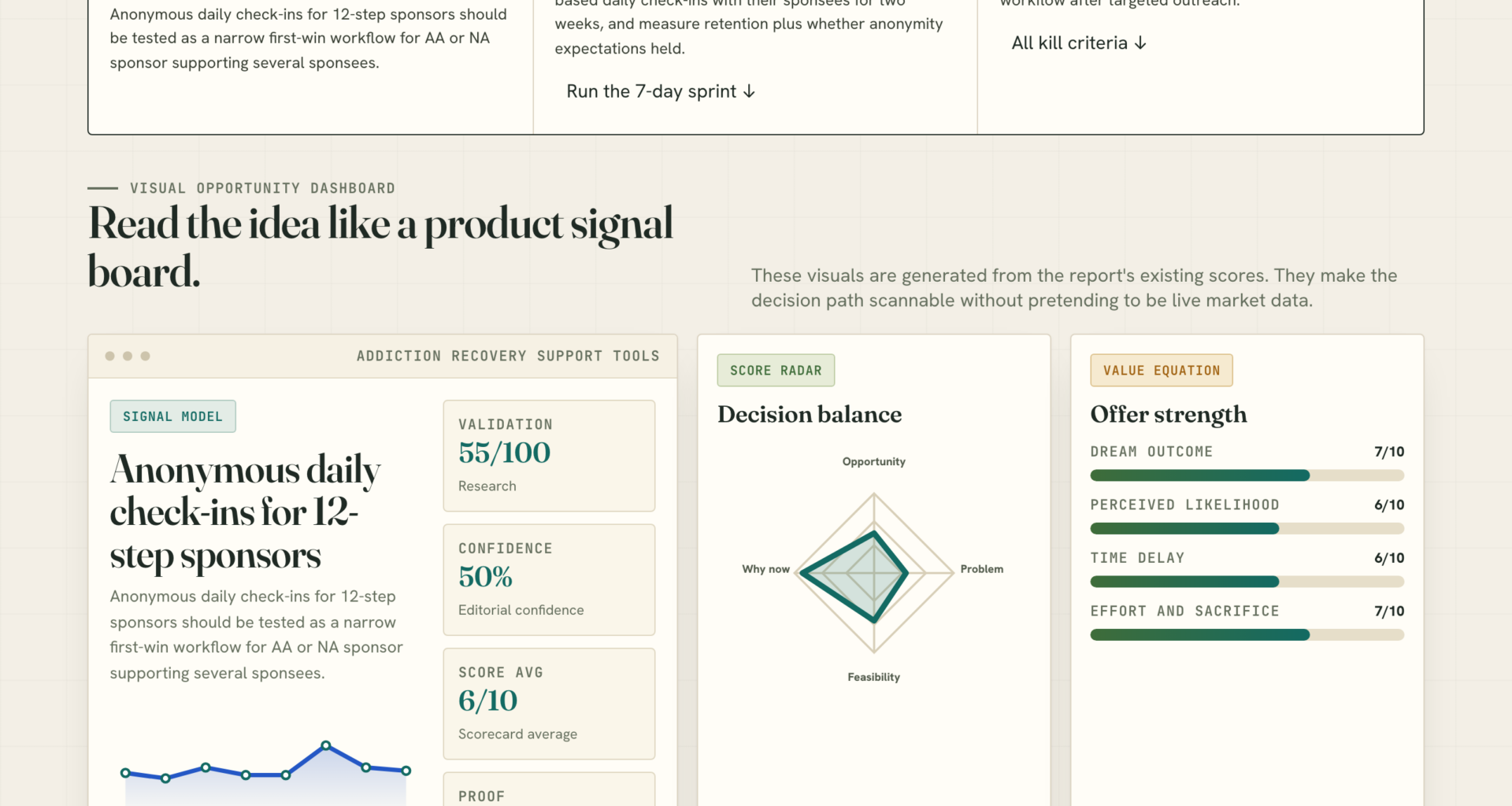

📊 Full opportunity report: Anonymous daily check-ins for 12-step sponsors on IdeaNavigator AI — validation score, market gap, and execution plan.
TL;DR
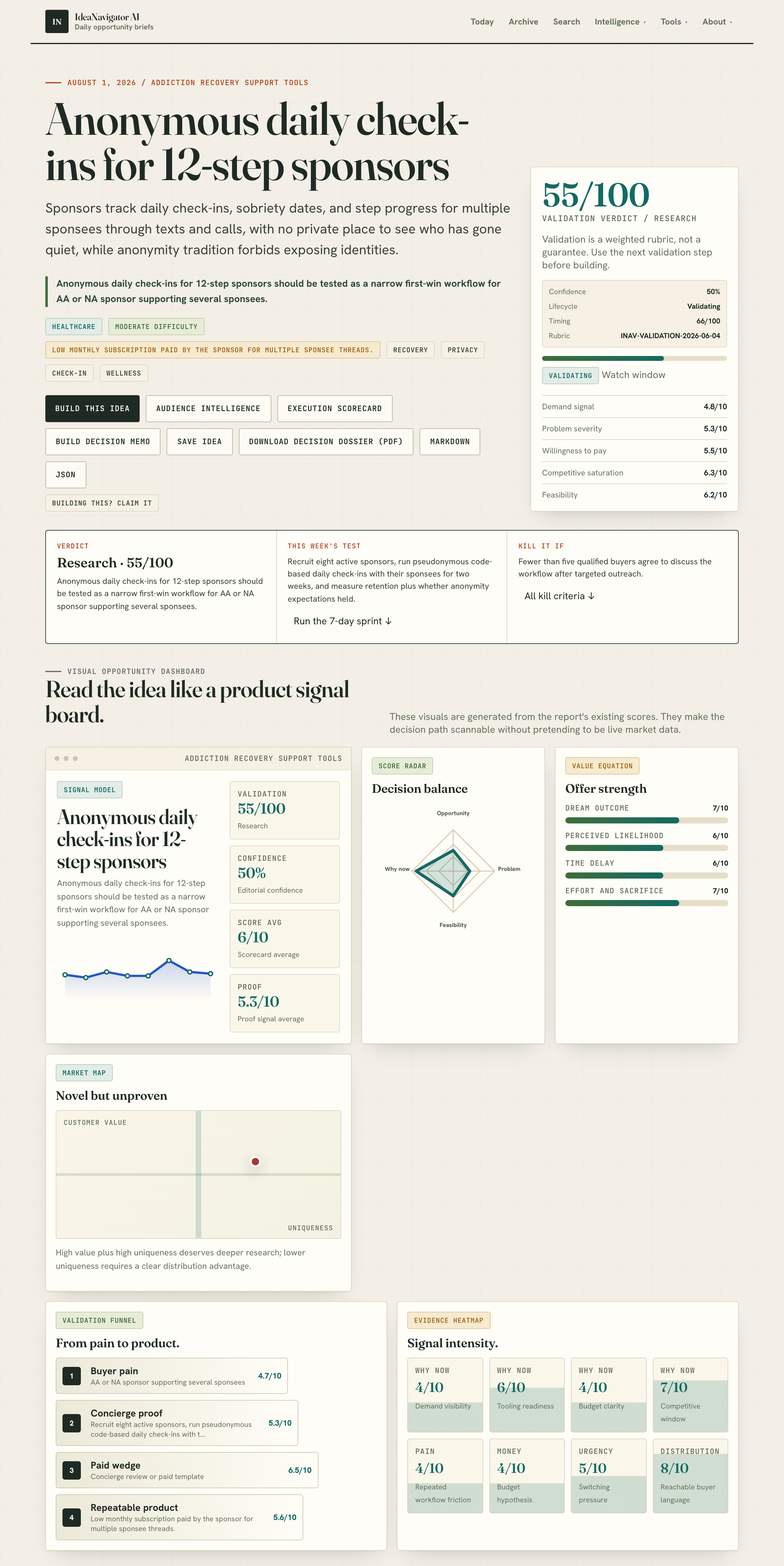
Researchers are testing a pseudonymous check-in app for 12-step sponsors supporting multiple sponsees. The system aims to enhance privacy while maintaining effective monitoring. The trial involves eight sponsors over two weeks to evaluate retention and anonymity adherence.
Researchers are testing a pseudonymous check-in system designed for 12-step sponsors supporting multiple sponsees, aiming to improve privacy and oversight without breaching anonymity traditions.
The initiative addresses the challenge sponsors face in tracking daily check-ins, sobriety dates, and step progress across several sponsees while maintaining strict anonymity. Currently, sponsors rely on texts and calls, which lack a private, centralized view of activity and can risk exposing identities.
The proposed solution involves a simple, code-based platform where sponsors invite sponsees via a one-time code, and sponsees submit daily check-ins with a green or red indicator and optional notes. This setup ensures no real names or phone numbers are stored, aligning with the program’s confidentiality principles.
According to an anonymous researcher involved in the project, the system will be tested with eight active sponsors over a two-week period. The goal is to measure retention, adherence to anonymity, and the system’s practicality in real-world recovery support.
Potential Impact on Privacy and Monitoring in Recovery
This development could significantly enhance privacy protections for individuals in recovery, addressing concerns over data leaks and identity exposure. For sponsors, it offers a streamlined way to monitor multiple sponsees without risking confidentiality breaches, which is especially relevant as recovery support increasingly moves onto digital platforms.
If successful, the system might influence how digital tools are integrated into twelve-step programs, balancing effectiveness with the core value of anonymity. It could also serve as a model for other confidential support networks seeking similar privacy solutions.

Recovery Matters – Sobriety Anniversary Sober AA NA Stainless Steel Insulated Tumbler
- Target Audience: AA members and supporters
- Gift Idea: Perfect for sobriety milestones
- Design: Exclusive AA novelty design
As an affiliate, we earn on qualifying purchases.
As an affiliate, we earn on qualifying purchases.
Shift Toward Digital Support and Privacy Challenges
Over recent years, addiction recovery support has shifted from in-person meetings to digital channels, especially via text messaging and apps. While this has increased accessibility, it has also raised concerns about privacy and confidentiality, as many mainstream messaging platforms do not guarantee anonymity or data security.
Traditionally, twelve-step programs like Alcoholics Anonymous and Narcotics Anonymous emphasize strict anonymity to protect members. However, the lack of a dedicated, private digital tool has led sponsors to track progress through informal means, risking inadvertent exposure of identities.
The proposed pseudonymous check-in system responds to these challenges by offering a secure, privacy-preserving alternative, with initial testing planned among a small group of sponsors before broader adoption.
“This system aims to provide a private, centralized way for sponsors to monitor multiple sponsees without compromising their anonymity.”
— an anonymous researcher

GALILEO® Double AA Big Book Cover & 12 Steps & 12 Traditions | Medallion Holder | AA Gift | Alcoholics Anonymous | PU Leather | AA Book Covers for Hardcover (Plain/Coin Pocket/Black)
- Book Compatibility: Fits 2 hardcover AA books
- Material: Durable PU leather with craftsmanship
- Privacy Feature: Strap keeps cover closed and private
As an affiliate, we earn on qualifying purchases.
As an affiliate, we earn on qualifying purchases.
Uncertainties Around Effectiveness and Adoption
It is not yet clear how well the pseudonymous check-in system will be received by sponsors and sponsees, or whether it will effectively replace existing tracking methods. The two-week pilot will provide initial data, but broader validation is still needed to confirm its practicality and adherence to anonymity standards.
Additionally, questions remain about potential technical issues, user acceptance, and integration with existing recovery routines. The long-term impact on privacy and monitoring effectiveness remains to be seen.

Caine Computer Forensics Bootable Linux USB for PC
- USB Compatibility: Supports USB-A and USB-C ports
- Customizable USB: Add, replace, or upgrade ISO apps
- Forensics Environment: Includes CAINE for digital investigations
As an affiliate, we earn on qualifying purchases.
As an affiliate, we earn on qualifying purchases.
Upcoming Pilot Results and Broader Implementation Plans
The initial pilot involving eight sponsors will conclude after two weeks, during which researchers will analyze retention rates and compliance with anonymity protocols. If results are positive, plans may include expanding the trial to more sponsors and refining the platform based on user feedback.
Further developments could see the system integrated into existing recovery apps or offered as a standalone service, with ongoing evaluation of privacy safeguards and usability.

Look at Me Getting Sober and Shit: A Recovery Journal: Sobriety and Addiction Notebook with Prompts , 122 Pages Sobriety Journal, Daily Sobriety Journal for Addiction Recovery with Health Tracker
As an affiliate, we earn on qualifying purchases.
As an affiliate, we earn on qualifying purchases.
Key Questions
How does the pseudonymous check-in system protect user identities?
The system uses one-time codes to invite sponsees and does not store real names or phone numbers, ensuring all check-ins are anonymous and privacy is maintained.
Will this system replace current sponsor-sponsee communication methods?
It is intended as a supplementary tool to improve privacy and tracking efficiency, not necessarily replacing calls or texts but providing a private monitoring platform.
Is this system officially endorsed by AA or NA?
No, it is a pilot project tested by researchers and sponsors; official endorsement would require broader validation and alignment with program principles.
Could this platform be used by other recovery groups or support networks?
Potentially, yes. Its privacy-focused design could appeal to various confidential support systems beyond twelve-step programs.
Source: IdeaNavigator AI