This guide shows you how to use a percussion massage gun to reduce muscle soreness, release tightness, and speed up recovery after exercise or long periods of sitting. You will learn how to pick the right attachment, set the correct speed, apply proper pressure, and work each muscle group for the right amount of time — all without bruising yourself or aggravating an injury.

Get health and wellness essentials delivered free — and shop member deals
- Fast, free delivery on millions of items
- Access to Prime Big Deal Days deals on October 6–7
- Prime Video, Amazon Music and more included

TOLOCO Deep Tissue Massage Gun with 10 Massage Heads
- ✔ Brand: TOLOCO
- ✔ Type: Cordless percussion massage gun
- ✔ Amplitude: 12 mm

RENPHO Active Thermacool 2 Massage Gun with Heat and Cold
- ✔ Heat levels: 4, up to 113°F (45°C)
- ✔ Cold levels: 4, down to 46°F (8°C)
- ✔ Speed: Up to 3200 RPM

TOLOCO Deep Tissue Massage Gun with 10 Massage Heads (7-Speed)
- ✔ Speed levels: 7
- ✔ Speed range: 2,200–3,300 rpm
- ✔ Massage heads: 10
This guide is written for beginners. No prior experience with massage guns, foam rolling, or physical therapy is assumed. A full-body or single-area session takes 10–20 minutes, and you can expect to finish with looser, warmer, less tender muscles and improved range of motion within minutes of completing the work.
Difficulty: Beginner | Time: 10-20 minutes per session
What You’ll Need
Tools & Materials:
- A percussion massage gun (any consumer model with adjustable speed settings)
- The attachment heads that came with the device (typically a round ball, flat head, bullet/pointer, and fork or U-shaped head)
- A charged battery — verify the device is charged or plugged in if it supports wired use
- Comfortable clothing that allows access to the muscles you want to treat, or short sleeves and shorts
- A chair, couch, or bed to support your body during the session
- Water to drink afterward
Knowledge:
- Basic familiarity with the names and locations of major muscle groups (calves, quads, hamstrings, glutes, back, shoulders, arms)
- Awareness of your own injuries, surgeries, or medical conditions
Safety check before starting: Do not use a massage gun over bones, joints, the front and sides of the neck, the spine itself, the groin, the armpits, the back of the knee, or any area with broken skin, bruises, varicose veins, or recent surgery. If you have a blood clot, deep vein thrombosis, a heart condition, nerve damage, are pregnant, or are recovering from an injury and unsure of its status, talk to a doctor or physical therapist first. A massage gun is a recovery tool for muscle tissue — not a treatment for acute injuries.
TOLOCO Deep Tissue Massage Gun with 10 Massage Heads
This TOLOCO earns our top spot because of one number that matters more than any other in this category: a 12 mm amplitude. That extra stroke depth compared with the RENPHO’s 10 mm lets the head travel deeper into dense muscle tissue, which is exactly what releasing a stubborn knot in a quad or glute actually requires. Speeds reaching 3,200 rpm give you headroom for both gentle flush-out work and aggressive deep-tissue sessions.The 10 replaceable massage heads are not filler — they map to distinct recovery jobs, from pinpoint work on trigger points to broad coverage on large muscle groups. Compared with the compact 7-speed TOLOCO below, this model trades a bit of portability for a more complete toolkit. The LED touch screen showing battery and speed is genuinely useful mid-session, and the 40–50 dB noise rating means you can use it on the couch without drowning out conversation.The tradeoffs are real but manageable. The charging plug is not included, so you’ll need to supply your own USB adapter, and the "up to 6 hours" battery claim shrinks noticeably at higher speeds. If you train daily and want a gun that can handle serious deep-tissue work across your whole body, though, this pick makes the most sense.
Pros:
- 12 mm amplitude reaches deeper into muscle tissue than the other picks
- 10 massage heads cover everything from trigger points to large muscle groups
- Quiet 40–50 dB operation suits shared spaces
- LED touch screen shows battery level and speed at a glance
Cons:
- Charging plug not included in the box
- Battery life drops noticeably at higher speeds
- No heat or cold therapy options
Best for: Athletes and regular lifters who need deep, targeted post-workout muscle release across large and small muscle groups
Not ideal for: Buyers who want a grab-and-go package with everything in the box, or who primarily want temperature therapy
Bottom line: The most complete deep-tissue recovery tool in this lineup, with the stroke depth to back up its claims.
“The most complete deep-tissue recovery tool in this lineup, with the stroke depth to back up its claims.”
RENPHO Active Thermacool 2 Massage Gun with Heat and Cold
Most massage guns — including both TOLOCO picks here — do one thing: percussion. The RENPHO Active Thermacool 2 differentiates itself by adding four heat levels up to 113°F and four cold levels down to 46°F, turning a single device into a two-stage recovery tool. Heat before training helps warm and loosen stiff tissue; cold after hard sessions helps calm inflammation. No other option in this lineup can do either.As a pure percussion device, it holds its own: 3,200 RPM, a 45 lb stall force that keeps the motor from bogging down under pressure, and a quiet 40 dB brushless motor. The 10 mm amplitude is slightly shorter than the flagship TOLOCO’s 12 mm, so it won’t dig quite as deep into stubborn knots — that’s the price of the temperature hardware.The most divisive feature is the 10-minute auto-off. It’s a sensible safety measure, especially with heat applied to skin, but it forces you to restart the device mid-session if you work through multiple muscle groups slowly. RENPHO also leaves charging time and battery replacement details unspecified, which makes long-term planning harder. This model is better suited to recovery-focused users who value the heat-cold workflow over maximum stroke depth.
Pros:
- Unique heat and cold settings cover both pre- and post-workout recovery
- 45 lb stall force maintains power under firm pressure
- Quiet 40 dB brushless motor
- Auto-off feature protects skin during heated sessions
Cons:
- 10-minute auto-off interrupts longer sessions
- 10 mm amplitude is shallower than the flagship TOLOCO’s 12 mm
- Charging time and battery replacement details not provided
Best for: Runners, athletes, and anyone managing recurring soreness who wants heat for warm-ups and cold for post-workout inflammation
Not ideal for: Users who want marathon massage sessions without interruption or maximum stroke depth for deep knots
Bottom line: The only pick that replaces two recovery tools — a massage gun and a hot/cold pack — in one device.
“The only pick that replaces two recovery tools — a massage gun and a hot/cold pack — in one device.”
TOLOCO Deep Tissue Massage Gun with 10 Massage Heads (7-Speed)
While the flagship TOLOCO goes deep, this 7-speed sibling focuses on refinement and portability. Its 2,200–3,300 rpm range is thoughtfully tiered: the lower settings are gentle enough for sensitive areas and recovery flush-outs, while the top speed approaches serious percussion territory. It’s the only pick here that runs at under 40 dB, making it the clear choice for apartments, offices, or late-night sessions.Its standout feature is the LED display showing real-time massage pressure, which neither sibling offers. If you tend to press too hard — a common cause of bruising and ineffective recovery — that feedback loop teaches better technique. The non-slip handle adds confidence when working sweaty post-workout, and the same 10-head selection keeps it versatile.Where it falls short is transparency: battery capacity and runtime are not specified, which is a meaningful gap if you travel or forget to charge devices. Compared with the flagship TOLOCO, you give up a bit of advertised stroke depth and battery clarity in exchange for quieter operation and pressure guidance. This option stands out as the best second massage gun, or the first one for a buyer who values guided, low-noise recovery sessions over brute depth.
Pros:
- Quietest option in the lineup at under 40 dB
- Real-time pressure display helps prevent pressing too hard
- 7 speed levels span gentle recovery to deep percussion
- Non-slip handle suits post-workout use
Cons:
- Battery capacity and runtime not specified
- Slightly less documented depth than the flagship TOLOCO
- No temperature therapy features
Best for: Apartment dwellers, travelers, and technique-focused users who want quiet operation and pressure feedback
Not ideal for: Buyers who need a guaranteed long battery runtime or maximum depth for very dense muscle tissue
Bottom line: The quietest and most feedback-rich pick here — ideal if low noise and guided technique matter more than raw depth.
“The quietest and most feedback-rich pick here — ideal if low noise and guided technique matter more than raw depth.”
As an Amazon Associate we earn from qualifying purchases.
Before You Start
Charge the device fully before your first session so it does not die mid-treatment. Lay out the attachments so you can swap quickly without interrupting the session. Identify the muscle or muscles that feel sore or tight — touching them and moving the joint through its range of motion beforehand helps you notice the difference afterward. Have a clock, timer, or phone stopwatch within view; the most common beginner error is working one spot far too long.
Step-by-Step Instructions
Step 1: Choose the right attachment for the muscle you are treating
Attach the head that matches the area you plan to work. Press the attachment onto the motor shaft until it clicks or seats firmly. Use these pairings:
- Large round ball head: large muscle groups — quads, hamstrings, glutes, calves. This is your default head for most of the body.
- Flat head: denser, broad areas like the chest, upper back, and shoulder blades.
- Bullet or pointer head: very small, precise spots like the palm of a tight calf, a knot in the forearm, or under the shoulder blade. Use this the least — it concentrates force.
- Fork or U-shaped head: areas that straddle bone or tendon, such as the calves along the Achilles or the muscles beside the spine. Never point the prongs directly at the spine.
Tip: If your device came with only one or two heads, start with the round ball head. It is the most forgiving for beginners.
Check: The attachment is seated firmly and does not wobble or pop off when you shake the device gently.
Step 2: Set the device to its lowest speed and turn it on
Power on the device and set it to the lowest speed setting. Do not start on high. Begin with the gun hovering just above the muscle without pressure, and let the percussion do the work. If your model has amplitude or pressure sensors, watch them; many devices show a warning light when you press too hard.
Tip: The correct starting pressure is roughly the weight of the device itself resting on the muscle. You should never need to lean your body weight into it.
Check: The device hums steadily at low speed and the head bounces lightly against your skin without stalling.
Step 3: Glide slowly over the muscle belly
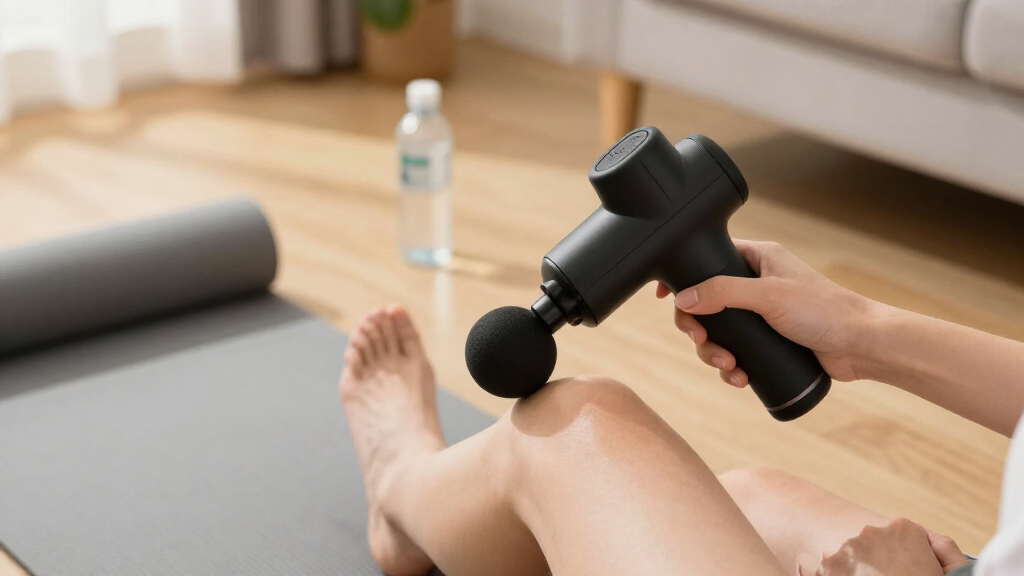
Place the moving head on the thickest part of the muscle — the muscle belly, not the tendon or bone. Move it slowly along the length of the muscle fibers at a rate of about one inch per second, roughly the speed of pouring syrup. Cover each muscle region in slow passes. When you find a tender or knotted spot, pause over it for 10–20 seconds only, keeping the pressure light, then continue gliding.
Tip: Slow movement is what makes the treatment effective. Gliding fast feels dramatic but does almost nothing. If a tender spot does not release after two short pauses, move on — forcing it causes bruising.
Check: After 1–2 minutes on a muscle, it should feel warmer and slightly looser. Mild tenderness is normal; sharp pain is not.
Step 4: Work each major muscle group for the right duration
Spend no more than 1–2 minutes per muscle group, and no more than 15 minutes total in one session. A typical lower-body sequence looks like this:
- Calves: 1 minute per leg, gliding from just above the Achilles to below the knee, avoiding the back of the knee itself.
- Quads: 1–2 minutes per leg, gliding along the front of the thigh from hip to just above the knee.
- Hamstrings: 1–2 minutes per leg, seated with the leg extended, working back of thigh to just above the knee.
- Glutes: 1–2 minutes per side, working the fleshy outer and upper portions.
For the upper body, treat the shoulders, upper back between the shoulder blades, lats, forearms, and chest for about 30–60 seconds each. Keep the gun moving at all times on these smaller areas.
Tip: Use a timer. Most people underestimate how long they have been on one spot by a wide margin.
Check: Every intended muscle group has received slow passes, and the total session has stayed under 15 minutes.
Step 5: Move the joint through its range of motion while treating tight areas
For stubborn tightness, combine the massage gun with movement. For example, while treating the calf, slowly flex and extend your ankle. While treating the quad, slowly bend and straighten the knee. While treating the shoulder area, slowly roll the shoulder or reach your arm overhead. Moving the joint while the muscle vibrates helps the fibers release under load, which is more effective than static treatment alone.
Tip: Keep the movements slow and controlled — this is not stretching, it is gentle motion under vibration.
Check: The joint feels easier to move through its full range immediately after the combined treatment.
Step 6: Increase speed only if the low setting feels insufficient
After your first full pass over the body, if an area still feels tight, repeat that area at a medium speed setting for another 30–60 seconds. Reserve the highest speeds for large, fleshy muscles like the glutes and quads, and only if your body tolerates medium speed comfortably. Never use the highest speed on the neck, forearms, or near bone.
Tip: More speed is not better recovery. It is more intensity, which carries more bruising risk. Most recovery work happens at low to medium settings.
Check: The treated muscles feel worked but comfortable — similar to how they feel after a light massage.
Step 7: Finish the session and rehydrate
Turn off the device before lifting it away from your skin. Wipe the attachment head with a disinfectant wipe or a cloth dampened with rubbing alcohol, let it dry, and store it with the device. Drink a glass of water, and note how the treated muscles feel. Take a few minutes to walk around and test your range of motion — squat, reach overhead, roll your shoulders — to confirm the effect.
Tip: Some mild soreness the next day is normal for a first session, similar to after a massage. Marked soreness or visible bruising means you used too much pressure or stayed too long in one spot.
Check: Muscles feel looser and warmer, range of motion is measurably improved versus your pre-session check, and there is no sharp pain or bruising.
Common Mistakes to Avoid
- Pressing too hard into the muscle — Let the device’s own weight and the percussion do the work. If the motor sound strains, slows, or stalls, or if your skin turns red-white and stays dented, you are pressing far too hard.
- Holding the gun on one spot for minutes to ‘crush’ a knot — Cap static holds at 10–20 seconds, two holds maximum per spot, then keep gliding. Sustained stationary percussion on one point is the leading cause of bruising.
- Using the gun over joints, bones, the neck, or the spine — Treat only the fleshy belly of muscles. Keep the head at least an inch away from any bony prominence, and never treat the front or sides of the neck.
- Using it immediately on an acute injury or fresh strain — Wait at least 48–72 hours after an acute injury, and get professional clearance first. Percussion on freshly injured tissue can increase swelling and bleeding. Use the gun for soreness and tightness, not acute pain.
Troubleshooting
Problem: The device stalls or the motor strains when touching the muscle
Solution: You are applying too much pressure. Lift off until the head barely rests on the skin. If it still stalls at light pressure on the lowest setting, the battery may be low or the motor may be underpowered for dense muscle — charge fully or use it on smaller muscle groups only.
Problem: Skin turns red, blotchy, or shows small bruises after a session
Solution: You used too much pressure or lingered too long in one area. Bruises typically fade within a week. For your next several sessions, use the lowest speed, lighter pressure, and constant movement, and skip the bruised areas entirely until healed.
Problem: The area feels more sore the day after treatment
Solution: This is usually a normal response for a first session, similar to post-massage soreness, and should resolve within 24–48 hours. Halve your session duration and pressure next time. If soreness is sharp, worsening after 48 hours, or accompanied by swelling, stop using the device and consult a medical professional.
Problem: Numbness, tingling, or a shooting sensation during use
Solution: Stop immediately — you are on or near a nerve. Nerve-related sensations feel electric or tingly rather than muscular. Move the head a couple of inches away onto pure muscle tissue and avoid that spot going forward. If tingling persists after the session, see a doctor.
What Success Looks Like
A successful session meets all of the following: the treated muscles feel warmer and noticeably looser within minutes; your range of motion in the worked joints is improved compared to your pre-session check (for example, a deeper squat or an easier overhead reach); you feel mild, comfortable muscle ‘worked’ sensation rather than sharp pain; you see no bruising or lingering redness; and the total session lasted under 15 minutes with no single spot treated for more than about 20 seconds at a time. If you used it post-workout, you should notice reduced stiffness the following day compared to typical recovery without the device.
Next Steps
Repeat sessions daily or every other day as needed — for post-workout recovery, use the gun within a few hours of training, and again the next morning if soreness lingers. Track what works: note which attachments, speeds, and durations produced the best results for your body. Pair the device with other recovery habits: hydration, light stretching after treatment, adequate sleep, and a proper warm-up before your next workout. Replace attachment heads if the foam cracks or compresses unevenly. If a specific tight spot or pain persists for more than two weeks despite regular recovery work, stop self-treating that area and see a physical therapist — persistent pain is diagnostic information, not something to percussion away.
Frequently Asked Questions
How long and how often should I use a massage gun?
Keep each muscle group to 1–2 minutes and total sessions under 15 minutes. Daily use is safe for most people at light pressure; every other day is plenty if you bruise easily or are new to it.
Should I use the massage gun before or after a workout?
Both work, for different purposes. Before a workout, use it for 30–60 seconds per muscle group as part of a warm-up to increase blood flow. After a workout or on rest days, use the full 1–2 minutes per group to reduce soreness and tightness.
Can I use a massage gun on my neck and back?
Use it only on the fleshy muscles at the top of the shoulders and along the sides of the spine on the upper back — never directly on the spine, the front or sides of the neck, or anywhere you can feel bone or pulse. For the neck, use the lowest speed and a soft attachment, or better, treat the upper traps instead.
Does a more expensive massage gun work better?
Amplitude (how deep the head travels) and motor stability under pressure matter more than price. A mid-range device with adjustable speed and a stall force above roughly 30 lbs handles most recovery work well. Attachments and battery life are worth comparing; extra cost beyond that mostly buys quieter operation and build quality.
Is it normal for a massage gun to hurt?
It should feel intense but tolerable — like a strong massage on sore muscle. Sharp, electric, or stabbing pain means you are on a nerve, bone, or injured tissue. Back off immediately, reduce pressure, and reposition on the muscle belly.
Fall Picks
fall essentials
As an affiliate, we earn on qualifying purchases.