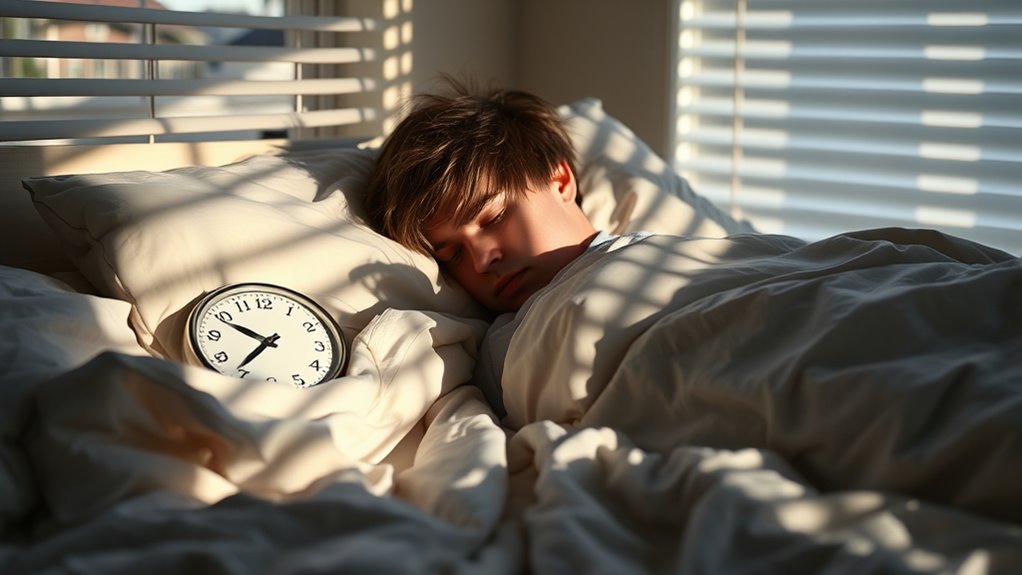

When daylight saving time shifts occur, they throw off your body’s natural sleep cycle, making it harder to fall asleep and wake up on time. This disruption can cause you to feel groggy, less alert, and moodier during the adjustment period. Your natural biological clock struggles to realign with the new schedule, which impacts your overall health and energy levels. To understand ways to minimize these effects and support your sleep, keep exploring how you can adapt smoothly.

Get health and wellness essentials delivered free — and shop member deals
- Fast, free delivery on millions of items
- Access to Prime Big Deal Days deals on October 6–7
- Prime Video, Amazon Music and more included
Key Takeaways
- DST shifts disrupt the body’s circadian rhythm, making it difficult to fall asleep and wake up at usual times.
- Sleep quality declines during the adjustment period, leading to increased fatigue and reduced alertness.
- Mood swings, irritability, and decreased concentration are common due to disrupted biological processes.
- Exposure to natural light and maintaining consistent sleep schedules can help realign the internal clock.
- Disrupted circadian rhythms impair overall health by affecting hormone production and immune function.

Daylight Saving Time (DST) can markedly impact your daily routines, health, and productivity. One of the most immediate effects is sleep disruption, which occurs when your body’s natural circadian rhythm is thrown off by the shift in the clock. Your circadian rhythm is like an internal clock that regulates your sleep-wake cycle, aligning it with the natural light-dark cycle of the environment. When the clocks jump forward or fall back, it creates a mismatch between your internal clock and the external world, making it harder to fall asleep or wake up at your usual times. This misalignment can leave you feeling groggy, less alert, and more fatigued, especially in the days immediately following the time change.
As your body struggles to adjust, you may notice your sleep quality diminishes. You might find yourself tossing and turning, waking up earlier or later than planned, or experiencing lighter sleep overall. This sleep disruption doesn’t just affect your nighttime rest; it can ripple into your daytime functioning, reducing your concentration, impairing your decision-making, and even weakening your immune system. Because your circadian rhythm influences hormone production, body temperature, and other crucial processes, any disturbance can throw off your overall health and wellbeing. The disruption isn’t just about missing sleep; it’s about the complex biological processes that rely on a steady rhythm. When these processes are out of sync, it becomes harder for your body to perform at its best.
You might also notice increased mood swings or irritability during the adjustment period. Your body’s internal clock responds to light cues, and when those cues shift suddenly, it takes time to recalibrate. During this adjustment, your sleep schedule may feel irregular, and you may experience a dip in your energy levels, which can hinder your productivity and overall mood. It’s common to see a spike in mistakes or accidents due to decreased alertness, especially in the first week after the time change. To mitigate these effects, it helps to expose yourself to natural light during the day, maintain a consistent sleep schedule, and avoid screens or stimulants close to bedtime. Being mindful of these strategies can help your circadian rhythm realign faster, reducing sleep disruption and helping you regain your normal energy and focus. Additionally, understanding your body’s natural biological clock can empower you to develop habits that support better adjustment during time changes.
sleep aid supplements for adjusting to daylight saving time
As an affiliate, we earn on qualifying purchases.
As an affiliate, we earn on qualifying purchases.
Frequently Asked Questions
How Does DST Impact Mental Health Long-Term?
DST can negatively impact your mental health long-term by causing circadian disruption, which throws off your internal clock. This disruption leads to mood fluctuations, making you feel irritable, anxious, or depressed. Over time, repeated adjustments can increase stress levels and compromise emotional stability. Staying consistent with sleep schedules and gradually adjusting your routines before time changes can help minimize these effects and support better mental health.
Are There Differences in DST Effects Across Age Groups?
Imagine your body’s internal clock as a symphony that shifts differently across generations. Younger people often adjust quickly, like a sprinter, while older adults may struggle, feeling out of tune with age-related sleep shifts. These generational circadian differences mean DST impacts each age group uniquely, with older folks more vulnerable to disrupted sleep patterns, mood swings, and health issues, emphasizing that time’s effects aren’t one-size-fits-all.
Can DST Disrupt Medication Schedules or Health Routines?
Yes, DST can disrupt your medication schedules and health routines. You might forget to take medications on time or struggle to stick to your usual routine due to the time change. To maintain medication consistency and health routine adherence, set reminders, adjust your schedule gradually before the change, and stay mindful of the new time. This helps prevent missed doses and keeps your health on track during DST alterations.
How Do Animals and Wildlife Respond to Time Changes?
Imagine animals as clockmakers, finely tuning their routines with nature’s rhythm. When time shifts, their behavior shifts too, like dancers adjusting to a new beat. Wildlife adaptation varies; some animals become confused, disrupting feeding and resting patterns, while others adapt quickly by sensing changes in light. You see, animals respond instinctively to time changes, but their ability to adapt depends on species and environment, affecting their daily activities profoundly.
What Are the Economic Costs Associated With DST Disruptions?
You might not realize it, but DST disruptions can hit your wallet through economic productivity losses and transportation delays. When clocks shift, workers often struggle to adjust, leading to decreased efficiency and missed deadlines. Transportation systems also suffer, with delays and scheduling issues increasing costs. Overall, these disruptions cost billions annually, affecting businesses, commuters, and the economy, highlighting how time changes can have significant financial repercussions.
blue light blocking glasses for sleep
As an affiliate, we earn on qualifying purchases.
As an affiliate, we earn on qualifying purchases.
Conclusion
As the clocks shift, you might notice your sleep feels just a touch off, like a gentle nudge rather than a jarring wake-up call. While the change can seem small, it’s a quiet reminder to be kind to your body and give yourself time to adjust. Embrace the subtle shifts, knowing that patience and a little self-care can help you find your rhythm again. After all, even in small moments, balance is worth preserving.
white noise machine for better sleep
As an affiliate, we earn on qualifying purchases.
As an affiliate, we earn on qualifying purchases.
light therapy lamp for circadian rhythm
As an affiliate, we earn on qualifying purchases.
As an affiliate, we earn on qualifying purchases.
Fall Picks
fall essentials
As an affiliate, we earn on qualifying purchases.