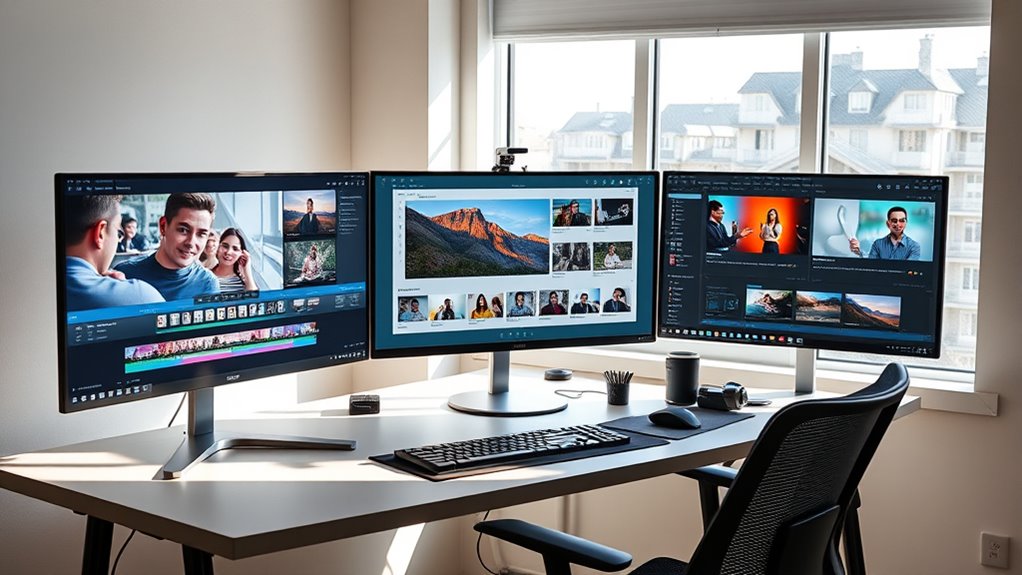

Choosing the right ultrawide monitor in 2026 involves balancing size, resolution, and features suited for video editing and multitasking. The Dell 34 Monitor S3425DW stands out for its vibrant colors and smooth performance, ideal for creative work. The CRUA 49-Inch DQHD Ultrawide offers immersive real estate for multitasking and gaming, but with limited built-in features. Meanwhile, the LG 34WR55QK-B presents a versatile, curved WQHD display with multiple connectivity options for a comfortable, productive setup. I’ll walk through these options and more to help you identify which monitor fits your workflow and budget.

Get health and wellness essentials delivered free — and shop member deals
- Fast, free delivery on millions of items
- Access to Prime Big Deal Days deals on October 6–7
- Prime Video, Amazon Music and more included
Key Takeaways
- Size and resolution directly impact multitasking efficiency and visual detail for editing.
- Curved screens improve immersion but may require more desk space and adjustments.
- Connectivity options like USB-C and HDR support enhance versatility for creative workflows.
- High refresh rates benefit gaming and smooth previewing, but may add cost and complexity.
- Ergonomic features are essential for long editing sessions, especially on larger ultrawides.


| ultrawide monitors for video editing and multitasking | Resolution | Screen Size | Refresh Rate |
|---|---|---|---|
| Dell 34 Monitor S3425DW | WQHD | 34 inches | 120Hz |
| CRUA 49-Inch DQHD Ultrawide Cu | 5120×1440 (DQHD) | — | 165Hz |
| LG 34WR55QK-B 34-inch UltraWid | 3440 x 1440 | 34 inches | 100Hz |
| Dell UltraSharp U4025QW 40-inc | 5K2K WUHD | 40 inches | — |
| Samsung 49” Business Curved Ul | Dual QHD | 49 inches | 120Hz |
More Details on Our Top Picks
Dell 34 Monitor S3425DW, WQHD VA, 120Hz, FreeSync Premium, Eye Comfort
The Dell S3425DW stands out for its lush, true-to-life colors thanks to 99% sRGB and 95% DCI-P3 coverage, making it well-suited for color-critical editing. The 120Hz refresh rate and FreeSync Premium ensure smooth, tear-free visuals, which can be beneficial during video playback or fast-paced multitasking. Its single USB-C port simplifies connectivity, reducing clutter on a busy desk. However, it lacks detailed ergonomic features, such as height adjustment, which might be a drawback for extended editing sessions. Compared with its curved counterparts, this model offers a flatter, more traditional viewing experience, but its price may be higher for some budgets. Overall, it’s an excellent choice if accurate colors and smooth performance are priorities.
Pros:- Vivid, true-to-life colors with wide sRGB and DCI-P3 coverage
- Smooth 120Hz refresh rate with FreeSync Premium
- Blue light reduction for comfortable viewing
- Single USB-C cable with 65W power delivery
Cons:- Limited ergonomic adjustments like height or swivel
- No detailed info on built-in speaker quality
- Potentially high price for budget-conscious users
Best for: Professional video editors and creative professionals needing accurate color reproduction.
Not ideal for: Gamers seeking the highest refresh rates or users needing extensive ergonomic adjustments.
- Screen Size:34 inches
- Resolution:WQHD
- Panel Type:VA
- Refresh Rate:120Hz
- Response Time:0.03ms
- Color Coverage:99% sRGB, 95% DCI-P3
Our verdict“The Dell S3425DW offers a compelling blend of color accuracy, smooth visuals, and simple connectivity, making it ideal for professional video editing and multitasking, despite some ergonomic limitations.”
CRUA 49-Inch DQHD Ultrawide Curved Gaming Monitor, 165Hz, FreeSync, Black
The CRUA 49-Inch DQHD offers an expansive, curved workspace that’s perfect for multitasking and immersive gaming. Its 5120×1440 resolution provides plenty of screen real estate, ideal for managing multiple apps or editing large video timelines. The 165Hz refresh rate and FreeSync support promise smooth visuals, especially during fast motion. However, the absence of built-in speakers means you’ll need external audio, which could clutter your setup. Its large size demands significant desk space and may be overkill for users with limited room or those primarily working on single projects. This monitor is best suited for users who want a giant, curved display for multitasking and gaming, and are willing to accept some compromises on built-in features.
Pros:- Large 49-inch curved display for immersive multitasking
- High 165Hz refresh rate with FreeSync support
- Adjustable stand with tilt, lift for ergonomic comfort
- Wide color coverage (120% sRGB)
Cons:- No built-in speakers, external audio needed
- Requires ample desk space due to size
- Limited HDR support
Best for: Multitaskers seeking an immersive display for productivity and gaming on a budget.
Not ideal for: Professionals who need precise color accuracy or built-in audio features.
- Size:49 inches
- Resolution:5120×1440 (DQHD)
- Refresh Rate:165Hz
- Curvature:1500R
- Color Coverage:120% sRGB
- Stand Adjustments:Height, tilt, lift
Our verdict“The CRUA 49-inch curved monitor delivers impressive screen real estate and performance at a budget-friendly price, but lacks integrated audio and extensive ergonomic features.”
LG 34WR55QK-B 34-inch UltraWide WQHD Curved Monitor, 100Hz, HDR10, HDMI, DisplayPort, USB-C, Adjustable Stand
The LG 34WR55QK-B balances size and features, offering a 34-inch curved display with WQHD resolution. It’s particularly suited for users who value flexibility, thanks to its USB-C port with 65W power delivery and adjustable stand. The HDR10 support enhances visual quality, especially in multimedia workflows. However, its 100Hz refresh rate is lower than some competitors, which might be noticeable during fast-paced editing or gaming. While it includes multiple connectivity options, the stand’s tilt and height adjustments contribute significantly to ergonomic comfort. Compared to more premium options, it might lack some advanced color calibration features, but it provides a strong value for versatile multitasking and creative projects.
Pros:- Large 34-inch curved display with immersive visuals
- Multiple connectivity options including USB-C with power delivery
- Adjustable stand for ergonomic comfort
- HDR10 support enhances multimedia experience
Cons:- Lower 100Hz refresh rate compared to gaming monitors
- Requires software for some features
- Limited details on built-in speakers
Best for: Creative professionals needing a flexible, ergonomic display for editing and multitasking.
Not ideal for: Gamers seeking high refresh rates or professionals requiring extensive color calibration.
- Screen Size:34 inches
- Resolution:3440 x 1440
- Aspect Ratio:21:9
- Refresh Rate:100Hz
- HDR:HDR10
- Ports:HDMI, DisplayPort, USB-C
Our verdict“The LG 34WR55QK-B offers versatile connectivity and ergonomic features in a curved WQHD package, suitable for creative work but not for high-refresh gaming.”
Dell UltraSharp U4025QW 40-inch Curved 5K2K WUHD LED Monitor
The Dell UltraSharp U4025QW offers a massive 40-inch curved display with 5K2K WUHD resolution, delivering exceptional clarity for detailed editing and multitasking. Its high resolution makes it ideal for professionals who need pixel-perfect precision, especially in color-sensitive tasks. The USB-C port supports fast data transfer and charging, reducing cable clutter. Its 600-nit brightness ensures visibility in bright environments, but the 5ms response time may fall short for fast-paced gaming. This monitor excels in productivity and multimedia environments, though its size and premium features come at a higher cost, making it less suitable for casual users or those with limited desk space.
Pros:- Massive 40-inch curved display with 5K2K resolution
- USB-C with fast data and power delivery
- High brightness for vivid visuals
- Excellent for detailed editing and multitasking
Cons:- Premium price point
- Response time may not suit fast gaming
- Size may require significant desk space
Best for: Creative professionals and productivity-focused users needing ultra-high resolution and large workspace.
Not ideal for: Competitive gamers or budget-conscious buyers seeking affordability.
- Screen Size:40 inches
- Resolution:5K2K WUHD
- Response Time:5 ms
- Brightness:600 Nit
- Viewable Screen:39.7 inches
- Connectivity:USB Type-C
Our verdict“The Dell UltraSharp U4025QW offers impressive resolution and size for professional creative workflows, but its price and size may limit accessibility for casual users.”
Samsung 49” Business Curved Ultrawide Dual QHD Computer Monitor, USB-C, DisplayPort, HDMI, 120Hz, VESA DisplayHDR 400, Built-in Speakers, Height Adjustable Stand, Eye Care, LS49C954UANXZA, 2024
The Samsung LS49C954UANXZA combines a 49-inch curved dual QHD display with VESA DisplayHDR 400, making it a powerhouse for multitasking, productivity, and entertainment. Its 120Hz refresh rate supports smooth visuals, complemented by multiple connectivity options including USB-C with 90W charging, and built-in speakers for convenience. The height-adjustable stand and TÜV-certified Eye Care technology promote comfort during long work sessions. While its size maximizes workspace, the 120Hz refresh rate isn’t available in Picture-by-Picture mode, and its brightness adjustments might fall short in very bright environments. This monitor is ideal for busy professionals who need a flexible, feature-rich display for extended use but may be less suitable for gaming or compact desk setups.
Pros:- Massive 49-inch curved display enhances multitasking
- USB-C with 90W charging reduces clutter
- VESA DisplayHDR 400 support for vibrant visuals
- Height adjustable stand for ergonomic comfort
Cons:- 120Hz not available in all modes
- Large size may be impractical for small desks
- Brightness adjustment limited in bright ambient lighting
Best for: Enterprise users who require a large, versatile workspace with ergonomic and connectivity features.
Not ideal for: Gamers seeking ultra-high refresh rates or users with limited desk space.
- Screen Size:49 inches
- Curvature:1000R
- Aspect Ratio:32:9
- Resolution:Dual QHD
- Refresh Rate:120Hz
- HDR:VESA DisplayHDR 400
Our verdict“The Samsung 49-inch ultrawide offers a flexible, feature-rich platform for demanding productivity, but its size and high-end features come with some limitations on gaming and space.”

How We Picked
Our selection process focused on monitors that excel in video editing and multitasking, prioritizing resolution, color accuracy, connectivity, and ergonomic features. We compared panel types, refresh rates, and HDR support to evaluate performance in creative workflows. Cost and build quality also influenced our choices, ensuring each monitor offers a distinct role for different user needs—whether for professionals, gamers, or general multitaskers. Our goal was to identify options that balance features, value, and practical tradeoffs for demanding users in 2026.
Factors to Consider When Choosing Ultrawide Monitors For Video Editing And Multitasking
Selecting the best ultrawide monitor for video editing and multitasking in 2026 involves understanding key features that impact your workflow. Size, resolution, and panel type influence image clarity and workspace. Connectivity options like USB-C and HDR support add versatility for creative tasks. Ergonomic features ensure comfort during extended use. I’ll guide you through these factors and help compare models suited for different needs, from professional editing to gaming and general multitasking.
Size and Resolution
The size of your monitor determines how much screen real estate you have for multitasking, while resolution affects clarity and detail. Larger screens like 49-inch models excel for immersive workflows but require more desk space. WQHD (3440 x 1440) strikes a balance for most users, offering ample space without overwhelming your setup. For detailed editing, higher resolutions like 5K or 4K are advantageous, but they often come at a higher price and demand more powerful hardware.
Panel Type and Color Accuracy
VA panels, like in the Dell S3425DW, deliver high contrast and vibrant colors, ideal for video editing where color precision matters. IPS panels offer even better color consistency and viewing angles, making them suitable for professional workflows. Color coverage, such as sRGB or DCI-P3, indicates how accurately the monitor reproduces colors — a critical factor for editing work. HDR support further enhances visual quality, especially for multimedia production.
Connectivity and Ergonomics
USB-C ports simplify cable management by providing data, video, and power through a single cable. Adjustable stands with tilt, height, and lift features improve comfort during long editing sessions. Consider monitors with ergonomic options and multiple ports if you frequently connect external devices or switch between tasks.
Refresh Rate and Additional Features
Higher refresh rates like 120Hz or 165Hz benefit gaming and smooth video playback, but may be less critical for static editing tasks. HDR support, built-in speakers, and response times can enhance multimedia workflows but often add to the price. Balance these features based on your primary use—creative editing versus gaming or general multitasking.
Frequently Asked Questions
Is a curved monitor better for video editing?
Curved monitors can reduce glare and provide a more immersive experience, which some find helpful for multitasking and detailed editing. However, they may distort straight lines and require more desk space. For professional color work, flat panels often offer more consistent viewing angles, but a curved screen can still be beneficial for a more natural viewing experience during long sessions.
What resolution should I look for in an ultrawide monitor for editing?
For precise editing and multitasking, a resolution of at least 3440 x 1440 (WQHD) is recommended, offering a good balance of detail and performance. Higher resolutions like 5K or 4K provide even sharper images but demand more powerful hardware. Consider your editing tools and hardware capabilities when choosing resolution to ensure smooth performance without bottlenecks.
How important is HDR support in these monitors?
HDR support enhances contrast and color range, making it especially useful for multimedia creators who work with high-dynamic-range footage. While not always essential for basic editing, HDR can improve visual accuracy and viewing experience, especially with monitors supporting VESA DisplayHDR standards. However, HDR implementation varies, so check the specific HDR level and coverage before choosing.
Should I prioritize refresh rate over color accuracy?
For video editing and multitasking, color accuracy and resolution tend to be more important than high refresh rates. While higher refresh rates benefit gaming and fast-motion video, they are less critical for editing workflows. Focus on monitors with good color coverage, calibration options, and resolution first, then consider refresh rate if you also plan to game or do fast-paced multimedia work.
Are built-in speakers necessary in an ultrawide monitor?
Built-in speakers can be convenient but often lack the audio quality professionals require. For editing and critical listening, investing in external speakers or headphones usually provides better sound. If space or simplicity is a priority, a monitor with decent built-in audio might suffice for casual use, but it’s generally not a substitute for dedicated audio equipment.
Conclusion
For professional video editors who need color accuracy and detailed visuals, the Dell S3425DW offers an excellent balance of features. Creative users seeking versatile connectivity and ergonomic comfort will find the LG 34WR55QK-B compelling. Gamers and multitaskers with ample desk space might prefer the expansive, immersive experience of the CRUA 49-Inch or the Samsung 49” for maximum workspace. Budget-conscious buyers should weigh the features they need most carefully, focusing on resolution and connectivity. Ultimately, your choice hinges on your workflow priorities, available space, and whether color accuracy, immersion, or multitasking volume matters most.
Fall Picks
fall essentials
As an affiliate, we earn on qualifying purchases.