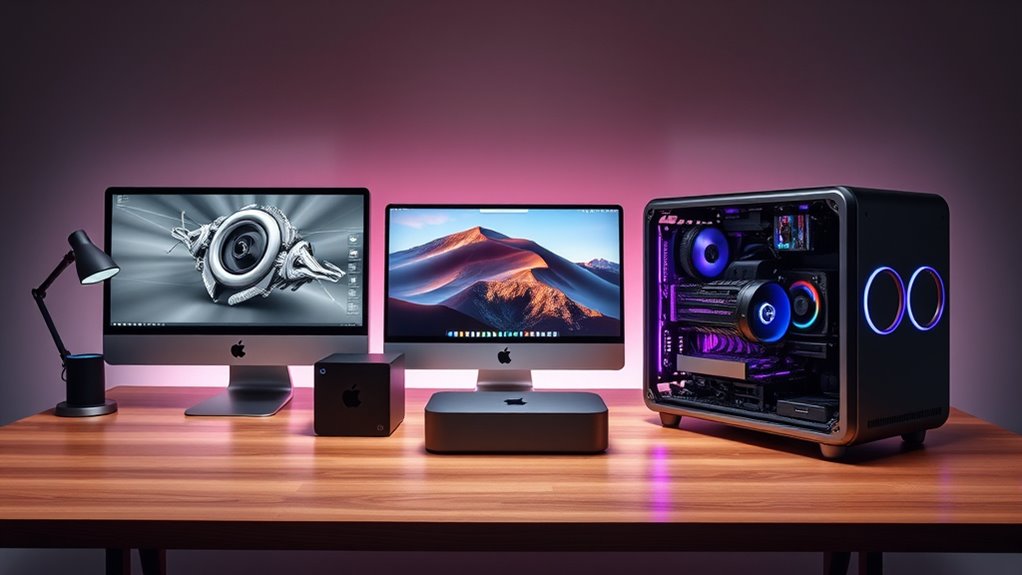

Choosing the right Mac Studio for 3D rendering in 2026 hinges on balancing raw power, expandability, and budget constraints. The Apple Mac Studio with M3 Ultra 28-Core CPU and 60-Core GPU leads in sheer performance but comes at a higher cost and size. The Mac Studio M3 Ultra with 32-Core CPU and 80-Core GPU offers even more GPU power for complex rendering tasks, making it ideal for professionals who need maximum GPU cores. Meanwhile, the Mac Studio M3 Ultra with 32-Core CPU and 80-Core GPU, 2TB SSD balances top-tier performance with fast storage, but its premium price limits accessibility. Each choice involves tradeoffs around cost, expandability, and ecosystem reliance, which I’ll explore in detail.

Get health and wellness essentials delivered free — and shop member deals
- Fast, free delivery on millions of items
- Access to Prime Big Deal Days deals on October 6–7
- Prime Video, Amazon Music and more included
Key Takeaways
- The M3 Ultra chips dramatically boost 3D rendering performance over previous M1 or M2 models.
- While GPU core count is crucial for rendering speed, memory and storage configurations also impact workflow efficiency.
- Higher-end configurations come with premium costs and size considerations that may influence workspace planning.
- Connectivity options like Thunderbolt 5 enable seamless connection to high-res displays and peripherals essential for professionals.
- Choosing between these options depends heavily on your rendering complexity, budget, and future expansion needs.
| Apple Mac Studio with M3 Ultra 28-Core CPU and 60-Core GPU, 256GB Storage |  | Best Overall Powerhouse for 3D Rendering | Processor: M3 Ultra 28-Core CPU | Graphics: 60-Core GPU | Memory: 256GB Unified Memory | VIEW ON AMAZON | See Our Full Breakdown |
| Apple Mac Studio M3 Ultra with 32-Core CPU, 80-Core GPU, 256GB Storage | | Best for GPU-Intensive Rendering Tasks | Processor: M3 Ultra 32-Core CPU | Graphics: 80-Core GPU | Memory: 256GB Unified Memory | VIEW ON AMAZON | See Our Full Breakdown |
| Apple Mac Studio M3 Ultra with 32-Core CPU, 80-Core GPU, 256GB Storage | | Best for Power Users Needing Fast Storage | Processor: M3 Ultra 32-Core CPU | Graphics: 80-Core GPU | Memory: 256GB Unified Memory | VIEW ON AMAZON | See Our Full Breakdown |
| mac studio for 3d rendering | Processor | Graphics | Memory | Storage |
|---|---|---|---|---|
| Apple Mac Studio with M3 Ultra | M3 Ultra 28-Core CPU | 60-Core GPU | 256GB Unified Memory | 2TB SSD |
| Apple Mac Studio M3 Ultra with | M3 Ultra 32-Core CPU | 80-Core GPU | 256GB Unified Memory | 1TB SSD |
| Apple Mac Studio M3 Ultra with | M3 Ultra 32-Core CPU | 80-Core GPU | 256GB Unified Memory | 2TB SSD |
More Details on Our Top Picks
Apple Mac Studio with M3 Ultra 28-Core CPU and 60-Core GPU, 256GB Storage
This Mac Studio stands out for its massive processing power thanks to the M3 Ultra with a 28-core CPU and 60-core GPU. It’s ideal for those tackling complex 3D scenes, simulations, or high-res rendering projects. Compared with the other options, it offers more CPU threads and GPU cores, translating directly into faster rendering times. The 256GB RAM and 2TB SSD support large files and multitasking, while connectivity options like Thunderbolt 5 and HDMI 2.1 make connecting multiple high-res displays and peripherals straightforward. However, this configuration comes with a steep price and a sizable chassis that demands dedicated workspace. Overall, it’s best suited to professional studios or power users needing maximum compute capacity.
Pros:- Unmatched CPU and GPU power for demanding rendering tasks
- Supports up to 8K resolution across multiple displays
- Extensive connectivity for peripherals and networks
- Fast SSD storage and ample memory
Cons:- High cost for top-tier specs
- Large form factor may require dedicated workspace
Best for: high-end professional 3D artists and studios
Not ideal for: casual users or those on a tight budget
- Processor:M3 Ultra 28-Core CPU
- Graphics:60-Core GPU
- Memory:256GB Unified Memory
- Storage:2TB SSD
- Display Support:Up to 8K, 8 displays
- Connectivity:Thunderbolt 5, USB 3, HDMI 2.1, 10Gb Ethernet
Our verdict“This model offers exceptional performance for serious 3D rendering, but at a premium price and size.”
Apple Mac Studio M3 Ultra with 32-Core CPU, 80-Core GPU, 256GB Storage
This Mac Studio emphasizes GPU power, with an 80-core GPU paired with a 32-core CPU, making it perfect for rendering scenes with complex shading, textures, and GPU-accelerated workflows. It supports multiple 8K displays, ensuring immersive visual setups. Compared to the first option, it offers even more GPU cores, which can significantly cut down rendering times in GPU-heavy projects. The 256GB RAM and fast SSD help handle large project files efficiently. Its main drawback is the high price and limited information on expandability—upgrades are not straightforward, and it’s locked into Apple’s ecosystem. This pick is best for GPU-bound workflows that demand maximum acceleration and are less concerned about future upgrades.
Pros:- Exceptional GPU core count accelerates complex rendering
- Supports multiple high-resolution displays
- Fast storage and ample memory support large projects
Cons:- Very high cost
- Limited upgrade options
Best for: GPU-centric 3D rendering professionals
Not ideal for: users seeking upgradeability or lower budgets
- Processor:M3 Ultra 32-Core CPU
- Graphics:80-Core GPU
- Memory:256GB Unified Memory
- Storage:1TB SSD
- Display Support:Up to 8K, multiple displays
- Connectivity:Thunderbolt 5, USB 3, HDMI 2.1, 10Gb Ethernet
Our verdict“For GPU-heavy workloads, this Mac Studio offers unmatched rendering speed but at a steep price.”
Apple Mac Studio M3 Ultra with 32-Core CPU, 80-Core GPU, 256GB Storage
This configuration emphasizes maximum processing and GPU power with the same 32-core CPU and 80-core GPU as the previous, but doubles down on storage with a 2TB SSD. It’s ideal for professionals who work with huge project files or require fast access to large datasets during rendering. Supporting multiple 8K displays, it ensures visual clarity and flexibility in complex workflows. The primary tradeoff here is the high cost, which might be prohibitive for some users, especially given the limited upgrade paths. It’s best suited for those who prioritize storage speed and capacity alongside raw compute power.
Pros:- Exceptional CPU and GPU for demanding 3D tasks
- Fast and large SSD storage
- Supports multiple high-res displays
Cons:- Very costly
- Limited upgradeability
Best for: high-end creative professionals with large project needs
Not ideal for: entry-level users or those with limited budgets
- Processor:M3 Ultra 32-Core CPU
- Graphics:80-Core GPU
- Memory:256GB Unified Memory
- Storage:2TB SSD
- Display Support:Up to 8K, 8 displays
- Connectivity:Thunderbolt 5, USB 3, HDMI 2.1, 10Gb Ethernet
Our verdict“This model delivers top-tier compute and storage performance for demanding workflows, but at a premium price.”

How We Picked
Our selection process focused on evaluating the latest Mac Studio configurations powered by the M3 Ultra chip, emphasizing CPU and GPU cores, memory, storage, and connectivity—key factors for 3D rendering. We compared each model’s raw processing power, support for multiple high-resolution displays, upgradeability, and price points to identify which options best serve demanding creative workflows. Cost-to-performance ratios and user-centric features like expandability and connectivity played a significant role. Our goal was to find a curated lineup that balances extreme performance with realistic considerations for professional 3D artists in 2026.
| mac studio for 3d rendering | Processor | Display Support |
|---|---|---|
| Apple Mac Studio with M3 Ultra | M3 Ultra 28-Core CPU | Up to 8K, 8 displays |
| Apple Mac Studio M3 Ultra with | M3 Ultra 32-Core CPU | Up to 8K, multiple displays |
| Apple Mac Studio M3 Ultra with | M3 Ultra 32-Core CPU | Up to 8K, 8 displays |
Factors to Consider When Choosing Mac Studio For 3d Rendering
Selecting the best Mac Studio for 3D rendering involves assessing your project complexity, budget, and future expansion plans. The key factors include CPU and GPU power, memory capacity, storage speed, and connectivity options. For heavy rendering workloads, GPU cores and memory bandwidth matter most. If your projects involve large datasets or high-res textures, fast SSDs and ample RAM are equally important. Considering your workspace size and whether you anticipate future upgrades can influence your choice. Below, I break down the main considerations to help you align your needs with the right Mac Studio configuration.Performance Needs
If you’re working on highly complex 3D scenes, simulations, or rendering large textures, prioritize models with higher GPU core counts and faster CPUs. The M3 Ultra chips with 32 cores offer more GPU acceleration, significantly reducing rendering times. For CPU-bound projects, a higher core count helps with scene compilation and processing. Balance these with your workflow demands to avoid overpaying for power you won’t fully utilize.
Memory and Storage
Large projects benefit from expansive RAM and fast SSDs. While 256GB RAM is currently ample for most professional workflows, some users might need even more for very large datasets. Fast SSDs minimize load times and help handle large files during rendering. If storage capacity is critical, opt for configurations with 2TB SSD, but be aware that this increases the overall cost.
Connectivity and Expandability
High-end 3D work often involves multiple displays, external GPUs, and fast networking. Thunderbolt 5 support facilitates connecting several 8K displays and high-speed peripherals. However, note that expandability options are limited—these machines are designed for high performance rather than future hardware upgrades. Your workflow should match this static configuration or involve cloud rendering for scalability.
Frequently Asked Questions
Is the Mac Studio suitable for intensive 3D rendering?
Yes, the Mac Studio equipped with the M3 Ultra chip, especially the models with higher GPU cores, is well-suited for demanding 3D rendering. Its combination of powerful CPU and GPU cores accelerates rendering times significantly, making it a strong choice for professional artists and studios. However, for extremely large or complex projects, GPU cores and memory capacity should match your workload to get the most benefits.
How does GPU core count impact rendering performance?
GPU core count directly influences rendering speed, especially in GPU-accelerated workflows common in 3D software. More cores mean better parallel processing, reducing the time needed to render complex scenes. The difference between models with 60 and 80 GPU cores can be substantial in rendering time, but this also depends on the specific software and workflow optimizations.
Can I upgrade the RAM or storage later?
Unfortunately, Apple’s Mac Studio models do not support user upgrades for RAM or storage. The configurations are fixed at purchase, so it’s important to choose the right specs upfront based on your current and future needs. For projects requiring more memory or storage, selecting higher specs initially is the best approach.
Are these Macs compatible with all 3D rendering software?
Most modern 3D rendering applications, such as Blender, Maya, Cinema 4D, and OctaneRender, have been optimized for Apple Silicon. Compatibility is generally strong, especially with native M3 support, but some niche plugins or older software might have limited support. Checking your primary tools’ compatibility before purchase can prevent workflow disruptions.
What about cooling and noise levels during rendering?
Mac Studio designs are optimized for quiet operation even under heavy loads. They employ efficient cooling systems that balance performance and noise, making them suitable for noise-sensitive environments. During intensive rendering, expect some increased fan activity, but overall noise levels remain lower compared to traditional desktop workstations.
Conclusion
If your focus is on maximum raw rendering speed with future-proof GPU power, the Mac Studio M3 Ultra with 32-Core CPU and 80-Core GPU is the best fit. For those needing a balanced setup that excels in both CPU and GPU tasks without overextending financially, the 28-Core CPU, 60-Core GPU model offers excellent value. Power users with large datasets should consider the 2TB storage version for faster data access. Casual users or hobbyists should avoid these high-end configurations and consider less expensive options or cloud rendering services. Your choice should align with your project complexity, budget, and whether expandability is a priority.
Fall Picks
fall essentials
As an affiliate, we earn on qualifying purchases.