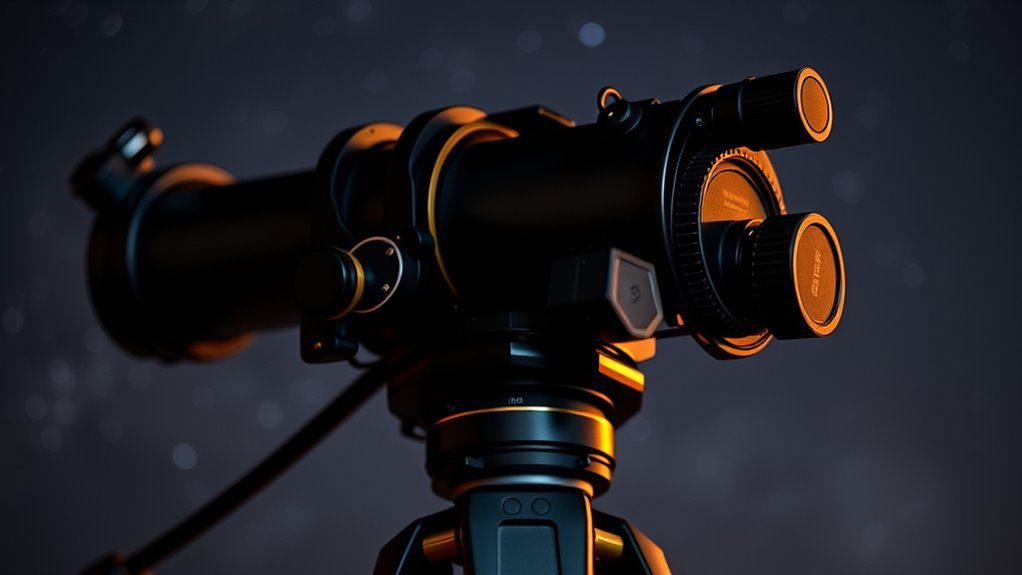

If you’re looking for the top equatorial mount with a belt drive for precision astrophotography, I recommend the PMC-Eight system. It offers a high load capacity, smooth belt drive operation, and excellent stability, all essential for long exposure imaging. Its user-friendly setup and compatibility with various accessories make it ideal for both beginners and advanced users. Keep exploring to discover why this mount stands out when it comes to delivering sharp, accurate celestial images.
Key Takeaways
- Look for mounts with high load capacity to support heavy telescopes and accessories without slippage or tracking issues.
- Prioritize models featuring high-quality, tensioned belt drives for smooth, quiet, and precise celestial tracking.
- Ensure the mount offers stable tripod construction and vibration damping for sharp astrophotography images.
- Choose mounts with user-friendly setup, alignment aids, and remote control options for efficient operation.
- Verify compatibility with various accessories, software, and power sources to maximize flexibility and functionality.
PMC-Eight Equatorial Tracker System Tripod and Mount for Astrophotography
https://m.media-amazon.com/images/I/61iEQesc8fL._AC_SX679_.jpg
If you’re serious about astrophotography and need a reliable, precise mount, the PMC-Eight Equatorial Tracker System is an excellent choice. Its integrated Explore Scientific PMC-Eight system features eight independent CPUs, outperforming single-processor models with superior responsiveness and efficiency. The mount’s dual-axis worm gears with quiet stepper belt drives ensure smooth, accurate movement, and the clutched RA and Declination axes make balancing effortless. Setup is quick thanks to the polar alignment sight hole and altitude control, eliminating the need for a polar scope. Plus, wireless control via WiFi and Bluetooth, along with an intuitive app, simplifies operation and celestial navigation.
Best For: serious astrophotographers and astronomy enthusiasts seeking a highly responsive, precise, and easy-to-operate equatorial tracking system.
Pros:
- Equipped with eight independent CPUs for superior responsiveness and processing power
- Smooth and accurate movement thanks to dual-axis worm gears with quiet stepper belt drives
- Simplified setup with polar alignment sight hole and intuitive ExploreStars app control
Cons:
- May be more expensive than single-processor or less advanced mounts
- Requires familiarity with app-based control for optimal use
- Potentially heavier and bulkier due to advanced features and integrated system
Factors to Consider When Choosing Equatorial Mounts With Belt Drive Systems

When selecting an equatorial mount with a belt drive system, I focus on several key factors to make certain I get the right fit. Things like load capacity, precision, stability, setup ease, and compatibility all play a role in making the best choice. Understanding these points helps me find a mount that meets my specific astrophotography needs efficiently.
Load Capacity Limits
Ever wonder how much weight an equatorial mount with a belt drive system can handle? The load capacity is vital because it defines the maximum safe weight the mount can support for astrophotography or visual observing. Going beyond this limit risks belt slippage, decreased tracking accuracy, and damage to the drive components. Mounts designed for heavier loads usually feature stronger belts, gears, and motors to manage the extra weight reliably. To guarantee optimal performance and avoid undue wear, it’s essential to match your telescope and accessories to the mount’s specified load capacity. Manufacturers typically list this in pounds or kilograms. Sticking within these limits helps preserve your equipment’s longevity and guarantees precise, steady tracking during your celestial adventures.
Belt Drive Precision
Choosing the right equatorial mount with a belt drive system hinges on understanding how various factors influence tracking precision. Belt drives offer smoother, quieter operation and better shock absorption than traditional gears, which helps maintain accurate tracking. High-quality belts with tight tensioning are essential; they reduce backlash and periodic error, ensuring precise polar alignment. Proper manufacturing and calibration of belt tension are critical—any slack or uneven tension can cause tracking inconsistencies. The elasticity of belts allows them to absorb minor shocks, minimizing vibrations that could blur astrophotographs. Overall, selecting a belt drive system that uses exceptional belts and meticulous tensioning ensures superior tracking, making it easier to capture sharp images with minimal post-processing. This focus on precision is fundamental for astrophotography success.
Mount Stability Features
A stable equatorial mount is essential for high-quality astrophotography, and its stability largely depends on the design and build quality of its components. A sturdy tripod with solid legs minimizes vibrations that can blur images. High-quality belt drive systems help reduce backlash and gear slop, ensuring smoother tracking of celestial objects. Precise balancing of the telescope and counterweights prevents undue stress on drive components and maintains stability during long exposures. Incorporating dampening materials or shock absorption features can further improve stability by absorbing vibrations and sudden movements. Locking mechanisms on the axes are also critical, as they secure positions and prevent drift during imaging sessions. Together, these features create a stable platform fundamental for capturing sharp, detailed astrophotos.
Ease of Setup
When selecting an equatorial mount with a belt drive system, ease of setup becomes a crucial factor that can save you time and frustration before astrophotography sessions begin. Many models feature simplified alignment procedures, often with built-in polar alignment aids like sight holes or quick-adjust controls that speed up the process. Wireless connectivity options such as WiFi or Bluetooth allow for remote control and calibration, reducing the need for extensive wiring. Additionally, dual-axis worm gears with belt drives provide smooth, precise movement, minimizing manual adjustments during setup. Portable, lightweight tripods also make assembly quick and straightforward, helping you get your equipment ready in less time. Prioritizing these features ensures a hassle-free setup, letting you focus more on capturing stunning astrophotos.
Compatibility Options
Compatibility options play a significant role in guaranteeing your equatorial mount with a belt drive system integrates well with your existing equipment and future plans. It’s vital to verify if the mount supports various telescope sizes, optical tube types, and accessory attachments, providing the flexibility needed for different astrophotography setups. Most belt drive mounts support standard mounting interfaces like Vixen, Losmandy, or D-style dovetails, making it easier to switch or upgrade gear. Adjustable belt tension and modular components help accommodate different payload weights and configurations. Additionally, confirming compatibility with control software and remote operation features ensures seamless integration into your imaging workflow. Don’t forget to verify compatibility with power sources, such as AC adapters or portable batteries, to avoid interruptions during long sessions.
Control System Integration
Choosing an equatorial mount with an integrated control system is essential for achieving precise tracking and smooth operation. A good control system enhances accuracy through precise motor control and feedback, minimizing errors during astrophotography. Wireless features like WiFi and Bluetooth make it easy to control the mount remotely and transfer data seamlessly. Compatibility with user-friendly apps simplifies star alignment, celestial navigation, and remote operation, making setup more straightforward. Advanced systems can automatically perform polar alignment, calibration, and periodic error correction, ensuring ideal tracking. Reliable integration synchronizes belt drive movement, reducing backlash and vibrations that can compromise image quality. Overall, a well-designed control system elevates your astrophotography experience by providing stability, precision, and ease of use.
Frequently Asked Questions
How Do Belt Drive Systems Improve Tracking Accuracy?
Belt drive systems improve tracking accuracy by reducing gear backlash and minimizing vibrations, which helps me keep stars pinpoint sharp during long exposures. The belts provide smoother, quieter motion compared to traditional gears, so I experience less jitter and more precise control. This means I can capture clearer images of deep-sky objects without needing excessive adjustments, making belt drives essential for high-quality astrophotography.
Are Equatorial Mounts With Belt Drives Suitable for Beginner Astrophotographers?
Absolutely, equatorial mounts with belt drives are great for beginners. They’re typically easier to set up and operate compared to traditional gear systems, offering smooth and quieter tracking. Plus, their improved accuracy makes capturing clear images easier, even if you’re just starting out. I recommend them because they provide a good balance of performance and user-friendliness, helping you grow your astrophotography skills without feeling overwhelmed.
What Maintenance Is Required for Belt Drive Systems?
Like tuning a vintage radio, maintaining belt drive systems keeps them humming smoothly. I regularly check for belt tension—too tight or loose can affect accuracy—and clean the belts with a soft cloth to remove dust. Lubrication isn’t usually needed, but I inspect gears and motors for wear. Keeping everything aligned and free of debris guarantees my mount performs precisely, just like a well-maintuned instrument, for stunning astrophotography.
Can These Mounts Handle Heavy Optical Equipment?
Yes, many belt drive equatorial mounts can handle heavy optical equipment, but it depends on their load capacity. I always check the manufacturer’s specifications to guarantee the mount’s weight limits match my gear. For heavier setups, I opt for mounts with higher payload capacities and sturdy construction. Proper balancing and regular maintenance also help prevent strain, ensuring smooth tracking and long-term performance.
How Do Belt Drive Mounts Compare in Noise Levels?
Belt drive mounts are noticeably quieter than traditional gear systems, making them ideal if you’re sensitive to noise during late-night observations. I’ve found their smooth operation minimizes vibrations and reduces mechanical whine, allowing for more peaceful astrophotography sessions. This quietness not only enhances your experience but also helps maintain stability, so you get sharper images. Overall, belt drive mounts are a great choice for anyone seeking a quieter, more refined tracking performance.
Conclusion
Choosing the right equatorial mount with a belt drive transforms astrophotography from a challenge into a seamless experience. Imagine your telescope gliding smoothly across the night sky, capturing stars with pinpoint accuracy, almost as if the universe itself is aligning for you. With the right system, you’re not just observing—you’re immersing yourself in the cosmos. Trust me, the right belt drive mount makes those breathtaking shots feel just within reach.