
📊 Full opportunity report: Postpartum Recovery Tips Tailored To Your Delivery Method And Maternal Health Apps on IdeaNavigator AI — validation score, market gap, and execution plan.

Get health and wellness essentials delivered free with Prime
- Fast, free delivery on millions of items
- Prime Video, Amazon Music and more included
- Member-only deals all year
TL;DR

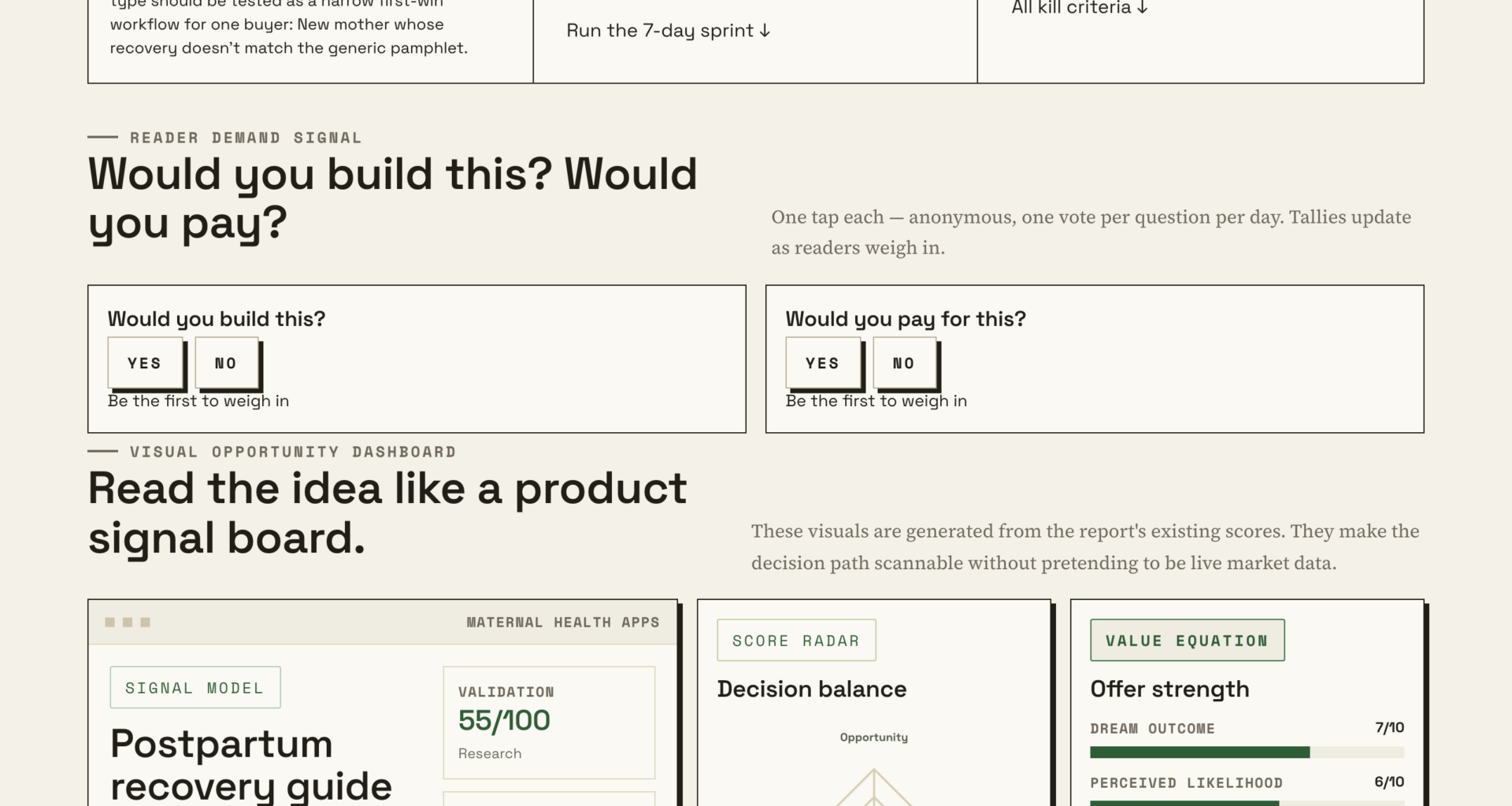
IdeaNavigator AI has outlined a maternal health app concept that would tailor postpartum recovery guidance to a user’s delivery, interventions, complications and feeding. The proposal calls for a 200-mother pilot through week six, but provides no evidence that the guide has been built, tested or adopted by hospitals.
IdeaNavigator AI has proposed a pilot for a postpartum recovery guide that would tailor week-by-week information to a mother’s delivery details and health profile. The concept targets people whose recovery may not fit general discharge guidance, with a proposed 200-mother test through week six; no pilot results or evidence of a released product are provided. The details are from IdeaNavigator AI’s proposal, which does not report a completed study or product launch.
According to IdeaNavigator AI’s proposal, the app would begin with an intake covering delivery mode, interventions, complications and feeding. It would use those details to present recovery expectations by week, warning-sign checklists and a preparation summary for the six-week postpartum visit. The proposal describes these as planned features; it does not establish that the guide can make individualized clinical recommendations or has undergone clinical review.
The proposal focuses on situations such as an unplanned C-section, a fourth-degree tear or a hemorrhage, which can involve different recovery needs. It argues that general discharge materials may leave some mothers seeking answers online about symptoms. No survey, clinical data or interviews are cited in the proposal to quantify how often that occurs or show that the proposed app would address it.
To assess the concept, IdeaNavigator AI suggests enrolling 200 new mothers grouped by delivery type and measuring engagement through week six, along with use of the escalation checklists. The proposal also identifies two possible revenue routes: consumer subscriptions and licensing the guide to hospitals for discharge education. It reports no hospital partner, pricing, enrollment plan or findings from a completed pilot.
Testing Guidance After Different Deliveries
Postpartum recovery can vary with a person’s delivery and complications, so guidance that accounts for those details could help patients prepare for recovery and organize questions for a follow-up visit. IdeaNavigator AI’s proposal says its week-by-week format and appointment summary would make information relevant across the first six weeks, rather than treating delivery as a single, uniform event.
That potential benefit remains a hypothesis. The proposal reports no evidence on whether users would find the guidance accurate, understandable or useful, or whether checklist use would change care seeking or health outcomes. Those distinctions matter: engagement can show that people used an app, but by itself does not show that its advice improved recovery or safely identified a complication.
For hospitals, IdeaNavigator AI proposes licensing as a possible way to deliver patient education tailored to discharge circumstances. Adoption would depend on evidence and operational details the proposal does not include, such as clinical oversight, how guidance would be updated and how the tool would fit existing discharge processes. The concept therefore describes a testable product direction, not a demonstrated solution.
Products Worth Considering

Hyperice Normatec 3 Full-Leg Compression Boots, Standard Size

Hyperice Normatec Elite Wireless Compression Boots, Standard Size

Therabody JetBoots Prime Wireless Compression Boots, Short (Under 29-inch Inseam)
As an affiliate, we earn on qualifying purchases.
A Proposed App for Postpartum Care
IdeaNavigator AI’s proposal places the idea in a period of attention to postpartum follow-up and says new guidelines call for individualized care. It does not name those guidelines, give their publication dates or summarize their recommendations, so the specific policy basis cannot be assessed from the proposal alone.
The proposal’s product premise is that discharge education often treats delivery as one event type, while recovery may be shaped by the method of delivery and complications. The proposed guide would gather those details at intake and use them to organize education. The material does not specify which clinical sources would support its week-by-week expectations, who would review the content or how it would handle symptoms that warrant urgent evaluation.
The suggested six-week measurement period defines the initial scope of the pilot described by IdeaNavigator AI. The proposal does not describe follow-up beyond that point or explain how participants would be recruited, how delivery groups would be balanced, or how researchers would interpret checklist use. Those details would be needed to judge whether the test could support conclusions about different recovery profiles.
Pilot Design and Clinical Review
No results are available because IdeaNavigator AI describes the 200-mother pilot as a validation plan, not as a completed study. Its proposal does not say whether a team has begun development, whether a hospital has agreed to participate, or when enrollment might start.
The proposal also leaves open how the guide would distinguish routine recovery from warning signs, what sources and clinical reviewers would shape its advice, and how the tool would direct users to care. It does not state whether the app would be evaluated for safety, privacy, accessibility or performance across different patient groups. These are unresolved product and study questions, not reported failures.
Evidence Needed Before Wider Use
IdeaNavigator AI’s proposal names testing the concept with 200 new mothers, grouped by delivery type, as the next step. It suggests tracking engagement through week six and use of escalation checklists, but specifies no schedule or recruiting site. Results would help show whether users engage with the proposed material, though engagement alone would not establish clinical benefit.
Before any broader hospital use can be assessed, further details would be needed about the guide’s clinical review, evidence base, privacy practices and response to warning signs. The proposal gives no timeline for development, pilot publication or licensing discussions.
Source: IdeaNavigator AI
Key Questions
Has the postpartum guide been released?
The available description presents a product proposal and planned minimum viable product. It does not say that an app has been released.
What would the guide use to tailor its information?
The proposed intake would capture delivery mode, interventions, complications and feeding, then provide week-by-week expectations, warning-sign checklists and a six-week visit preparation summary.
Has the 200-mother pilot started?
The proposal recommends a pilot with 200 mothers, but gives no start date, recruitment details or results.
Would the app replace advice from a health professional?
The proposal describes a patient education tool and does not say it would replace professional care. It provides no details about clinical oversight or how users would be directed to care when symptoms arise.
Source: IdeaNavigator AI