
Choosing a Mac mini as a creator comes down to one central question: how much GPU and memory headroom does your work actually demand? The lineup spans from renewed M1 and Intel models that handle writing, web design, and light photo editing, all the way to the M5 Pro configuration with per-core Neural Accelerators built for AI-assisted editing and multi-display creative suites. My top pick for most working creators is the Mac mini M4 with 24GB RAM and 1TB SSD, because it balances render speed, memory capacity, and internal storage without paying for performance most editors will never touch. Video editors and 3D artists should look at the M5 Pro model, while budget-conscious creators testing the Apple ecosystem can start with a renewed M1. The tradeoffs are real: storage is not user-upgradeable, GPU cores matter more than CPU cores for most creative software, and saving money up front on RAM or SSD space can shorten a machine’s useful life considerably.

Get health and wellness essentials delivered free — and shop member deals
- Fast, free delivery on millions of items
- Access to Prime Big Deal Days deals on October 6–7
- Prime Video, Amazon Music and more included
Key Takeaways
- The M4 with 24GB RAM and 1TB SSD is the best all-round configuration because memory and storage, not raw chip speed, are what most creators run out of first.
- The M5 Pro is the only option here with Thunderbolt 5, 2.5Gb Ethernet, and per-core Neural Accelerators, making it the clear pick for AI-heavy and multi-display workflows.
- The M4 Pro offers more GPU cores than the base M4 but only 512GB of storage, so it suits creators who already rely on external SSDs.
- A renewed M1 is a legitimate entry point for light creative work, but 8GB of unified memory will bottleneck modern photo and video apps quickly.
- The renewed 2018 Intel model runs x86 software natively but lags far behind every Apple silicon option in creative performance and efficiency.
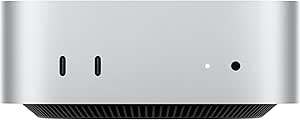


| mac mini configurations for creator | Storage | Chip | Memory |
|---|---|---|---|
| Apple Mac mini | 1TB SSD | Apple M4 | 24GB unified |
| Apple 2024 Mac mini Desktop Co | 512GB SSD | Apple M4 Pro | 24GB unified |
| Apple 2026 Mac mini Desktop Co | — | Apple M5 Pro | — |
| Apple Mac mini | 256GB SSD | — | 8GB unified |
| Apple Mac Mini Late 2018 | 512GB SSD | — | — |
More Details on Our Top Picks
Apple Mac mini (M4, 10-Core CPU, 10-Core GPU, 24GB RAM, 1TB SSD)
This configuration earns my top spot because it solves the problem that actually ends a Mac mini’s creative career: running out of memory and storage. With 24GB of unified memory and a full 1TB internal SSD, this is the one model in the lineup that a working photographer, designer, or hobbyist video editor can buy and forget about for years. The M4’s 10-core GPU handles 4K timeline scrubbing, RAW photo edits, and motion graphics previewing without the stutter you’d get on entry-level configurations.
Compared with the M4 Pro model below, this pick trades four GPU cores for double the internal storage, and I think that’s the right call for most creators. External SSDs are cheap, but keeping your active projects, applications, and system library on fast internal storage simplifies everything. Compared with the renewed M1, the difference is generational: more memory headroom, a faster GPU for effects rendering, and front-facing USB-C plus a headphone jack that make daily desk life easier. The drawback is honest: if your work leans heavily on GPU compute, 3D rendering, heavy color grading, or AI video tools, the 10-core GPU will become the ceiling before the memory does.
Pros:- 24GB of unified memory comfortably supports large photo libraries and 4K editing timelines
- 1TB internal SSD keeps active projects on fast storage without immediate external drive dependency
- Front-facing USB-C ports and a headphone jack make daily peripheral use convenient
- Compact 5-by-5-inch chassis fits any desk setup, including mounted behind a monitor
Cons:- Monitor, keyboard, and mouse are all sold separately
- 10-core GPU is the weakest link for heavy GPU rendering and high-end AI workloads
Best for: Photographers, designers, and video editors who want a balanced, long-lasting machine with ample memory and internal storage
Not ideal for: 3D artists, colorists, and creators running GPU-heavy AI pipelines who need more than 10 GPU cores
- Chip:Apple M4
- CPU:10-core
- GPU:10-core
- Memory:24GB unified
- Storage:1TB SSD
- Ports:Thunderbolt, HDMI, Gigabit Ethernet, front USB-C, headphone jack
- Dimensions:5 x 5 inches
- Environmental:Carbon neutral
Our verdict“The most sensible long-term configuration for the broadest range of creators, balancing memory, storage, and speed in one package.”
Apple 2024 Mac mini Desktop Computer with M4 Pro Chip, 12-Core CPU, 16-Core GPU, 24GB Memory, 512GB SSD, and Gigabit Ethernet
The M4 Pro configuration makes its case on GPU muscle and memory bandwidth: 16 GPU cores versus 10 on the base M4 means faster exports in Final Cut and Resolve, smoother playback with heavy color grades, and more breathing room for motion graphics. Paired with the same 24GB of memory as my top pick, this model targets creators whose bottleneck is render speed rather than project capacity.
Where it loses ground to the M4 is storage. Half the internal space at 512GB means your media library lives on external drives almost immediately, which is fine if you already own a fast Thunderbolt SSD and less fine if you don’t factor that cost into the purchase. Compared upward to the M5 Pro, this model also gives up Thunderbolt 5 bandwidth and the AI acceleration that’s becoming central to newer creative tools. Still, for an editor who keeps projects on external drives as standard practice, trading storage for GPU cores is a rational swap that saves money compared with the flagship.
Pros:- 16-core GPU delivers noticeably faster video exports and effects rendering than the base M4
- 12-core CPU handles multitasking across editing, browser, and reference apps without slowdown
- 24GB of unified memory matches the top pick for timeline and layer headroom
- Same compact footprint with front USB-C and headphone jack convenience
Cons:- 512GB SSD fills quickly for video work, pushing you toward external storage sooner
- No Thunderbolt 5 or next-generation AI acceleration found on the M5 Pro model
Best for: Video editors and motion designers who store media externally and want faster renders than the base M4 allows
Not ideal for: Creators who want everything on one internal drive, or those needing cutting-edge AI acceleration
- Chip:Apple M4 Pro
- CPU:12-core
- GPU:16-core
- Memory:24GB unified
- Storage:512GB SSD
- Ethernet:Gigabit Ethernet
- Dimensions:5 x 5 x 2 inches
- Weight:1.6 pounds
- Connectivity:Thunderbolt, HDMI, front USB-C, headphone jack
Our verdict“The smart middle path for render-focused creators who already work from external drives.”
Apple 2026 Mac mini Desktop Computer with M5 Pro Chip
If your creative work is drifting toward AI-assisted editing, generative tools, and multi-display production rigs, the M5 Pro is the configuration built for that future. Neural Accelerators in every GPU core push on-device AI performance to roughly four times the previous generation, which matters for creators running local image generation, AI noise reduction on video, or machine-learning-based masking. Add 307GB/s of memory bandwidth and storage that’s up to twice as fast, and this machine stops being a small desktop and starts behaving like a mobile workstation.
The connectivity story is also the strongest in this lineup: three Thunderbolt 5 ports, 2.5Gb Ethernet for fast network-attached storage, and support for up to three external displays. Compared with the M4 Pro, the difference shows up in sustained GPU workloads and in how quickly you can move large media files over wired connections, both of which compound daily on a professional desk. The honest tradeoff is that none of this power is user-upgradeable, and if your workload is conventional photo or document editing, you’d be paying a premium for headroom you won’t use. Peripherals, like every mini here, come separately.
Pros:- Up to 4x faster on-device AI performance with Neural Accelerators in each GPU core
- Three Thunderbolt 5 ports and 2.5Gb Ethernet support fast external and network storage
- Drives up to three external displays for expansive editing workspaces
- 307GB/s memory bandwidth keeps large projects and GPU workloads fluid
Cons:- Display, keyboard, and mouse not included
- No internal upgradeability, so configuration choices at purchase are permanent
Best for: Professional editors, 3D artists, and AI-focused creators who need maximum throughput and multi-display support
Not ideal for: Hobbyists and light-duty creators who would pay for dormant GPU and AI capacity
- Chip:Apple M5 Pro
- Form Factor:5 x 5 inch desktop
- AI Performance:Up to 4x faster with per-core Neural Accelerators
- Memory Bandwidth:307GB/s
- Rear Ports:3x Thunderbolt 5, HDMI, 2.5Gb Ethernet
- Front Ports:2x USB-C, headphone jack
- External Displays:Up to 3
- Wireless:Wi-Fi 7 (Apple N1), Bluetooth 6
Our verdict“The definitive choice for creators whose workloads are GPU-, AI-, and bandwidth-hungry enough to justify it.”
Apple Mac mini (2020) with M1 Chip, 8GB RAM, 256GB SSD, Silver (Renewed)
For creators testing whether a Mac mini fits their workflow at all, the renewed M1 is the lowest-risk way in. The M1’s 8-core CPU and GPU still handle 1080p video editing, Lightroom catalogs of moderate size, and graphic design work in Affinity or Canva with real competence, and the 16-core Neural Engine covers basic machine-learning features in photo apps. This option stands out for silent, efficient operation, something the Intel mini below can’t claim.
The limitation is structural, not superficial: 8GB of unified memory and 256GB of storage were tight when this machine launched and are genuinely constraining in 2026. Modern creative apps eat memory quickly, and you’ll be managing external storage from day one. Compared with the M4 pick, the gap shows up the moment you open a large RAW library or attempt a 4K multitrack edit. But as a first Apple silicon machine for a student, a writer who edits occasional videos, or a creator building a secondary render-free station, it does the job at a fraction of the cost, and the renewed condition keeps it accessible.
Pros:- M1’s 8-core CPU and GPU still handle 1080p editing and everyday design work smoothly
- 16-core Neural Engine supports AI photo features in modern creative apps
- Quiet, efficient Apple silicon operation at the most accessible entry point in the lineup
- Compact silver chassis matches newer minis in footprint
Cons:- 8GB of unified memory bottlenecks modern photo and video applications quickly
- 256GB SSD requires external storage for any serious media library
Best for: Students, beginners, and creators with light workloads exploring the Mac mini ecosystem inexpensively
Not ideal for: Anyone editing 4K video, working with large RAW libraries, or planning to keep the machine for years
- Model:Mac mini (2020), Renewed
- Processor:Apple M1, 8-core CPU
- Graphics:8-core GPU
- Neural Engine:16-core
- Memory:8GB unified
- Storage:256GB SSD
- Color:Silver
Our verdict“A sensible, affordable on-ramp to Apple silicon for light creative work, with clearly defined memory limits.”
Apple Mac Mini Late 2018, 3.0GHz Intel Core i5, 16GB RAM, 512GB SSD, Space Gray (Renewed)
I include this renewed 2018 Intel model for one narrow but legitimate reason: x86 compatibility. Some creators still depend on older plugins, legacy Windows-ported applications, or niche creative software that runs natively on Intel and only marginally, if at all, through translation on Apple silicon. For that user, this machine’s 3.0GHz Core i5, 16GB of RAM, and 512GB SSD are a workable, if aging, package, and the RAM in this generation is actually user-upgradeable, unlike every Apple silicon mini in this roundup.
For everyone else, this is the weakest creative performer here. Set against the renewed M1, it offers more memory and storage but falls behind in GPU-accelerated tasks, runs hotter and louder, and receives a shrinking window of macOS support. Against the M4, the performance gap is not close in any creative benchmark. The renewed condition brings its own caveats: non-original accessories, generic packaging, and a 90-day guarantee rather than Apple’s standard warranty. This pick makes sense only when software compatibility, not performance, drives the decision.
Pros:- Native x86 support for legacy creative software and older plugins
- 16GB RAM and 512GB SSD are workable specs for moderate workloads
- RAM is user-upgradeable, unlike all Apple silicon Mac minis
- Professionally inspected and backed by a 90-day replacement or refund guarantee
Cons:- Noticeably slower than every Apple silicon option in GPU-heavy creative tasks
- Runs hotter and louder, with a shrinking window of macOS support
- Renewed condition means non-original accessories and generic packaging
Best for: Creators tied to Intel-only legacy software who need native x86 support and upgradeable RAM
Not ideal for: Anyone who can use modern creative apps, since every Apple silicon option here outperforms it
- Processor:3.0GHz Intel Core i5
- RAM:16GB (user-upgradeable)
- Storage:512GB SSD
- Model Year:Late 2018
- Color:Space Gray
- Condition:Renewed, professionally inspected
- Warranty:90-day replacement or refund
Our verdict“A niche pick justified solely by Intel software compatibility, not by creative performance.”
How We Picked
My ranking logic for this comparison rests on three factors that matter disproportionately for creative work. First, unified memory capacity: photo libraries, timeline scrubbing, and layer-heavy design files live or die by RAM, and Apple’s unified memory architecture means you can never add more later. Second, GPU core count and storage speed, since most modern creative apps, from Final Cut to DaVinci Resolve, lean on the GPU for effects and exports. Third, longevity per dollar: a configuration that feels fast today but becomes the bottleneck in two years is a worse buy than a slightly more expensive one that lasts through several software generations. I also weighed connectivity, because creators frequently run external SSDs, color-accurate monitors, and card readers simultaneously, and port scarcity on a desktop is a daily frustration. Renewed models were judged on whether their specs still clear the minimum bar for 2026 creative software, not just on price appeal.
| mac mini configurations for creator | Chip |
|---|---|
| Apple Mac mini | Apple M4 |
| Apple 2024 Mac mini Desktop Co | Apple M4 Pro |
| Apple 2026 Mac mini Desktop Co | Apple M5 Pro |
| Apple Mac mini | — |
| Apple Mac Mini Late 2018 | — |
Factors to Consider When Choosing Mac Mini Configurations For Creators
Before choosing a configuration, it helps to understand which specs actually move the needle for creative work on a Mac mini, because Apple’s fixed configurations mean every choice at purchase is permanent.Unified Memory: The Spec You Can’t Fix Later
On a Mac mini, memory is soldered and shared between CPU and GPU, so 8GB is survivable only for light work, 16GB is a minimum for serious editing, and 24GB is the sweet spot for most creators in 2026. Memory pressure, not chip speed, is what causes beach balls when you open a large timeline alongside a browser full of references. If you’re torn between a faster chip and more RAM, take the RAM.
GPU Cores Determine Your Creative Ceiling
Modern creative software leans on the GPU for effects, color grading, AI masking, and export acceleration. The jump from a 10-core GPU to a 16-core GPU translates to shorter export times and smoother playback with heavy grades, while the M5 Pro’s per-core Neural Accelerators extend that advantage into on-device AI tools. Match GPU investment to how render-heavy your actual work is, not to benchmark scores.
Storage Strategy: Internal Versus External
Because SSD space is fixed, decide upfront whether your media lives internally or externally. A 1TB internal drive keeps everything fast and simple; a 512GB drive paired with a Thunderbolt SSD works well for video editors who already use external media as standard practice. Budget for external storage in your total cost if you choose a smaller configuration, and remember that Thunderbolt 5 on the M5 Pro makes external drives feel nearly internal in speed.
Ports and Displays Shape Your Desk
Creators accumulate peripherals: card readers, audio interfaces, calibration probes, reference monitors. The M5 Pro’s three Thunderbolt 5 ports and triple-display support suit a full production rig, while Gigabit Ethernet on lesser models is adequate but slower for network-attached storage. Front USB-C ports across the M4 generation make temporary connections painless, a small quality-of-life win worth not overlooking.
Is Renewed Worth It?
A renewed M1 can be a smart entry point if your expectations match its limits, but renewed Intel machines carry performance and support-timeline risks that make sense only for legacy software requirements. Check the guarantee terms, expect non-original accessories, and buy the newest renewed generation you can afford, since macOS support windows shrink with each passing year.
Frequently Asked Questions
Is 24GB of unified memory enough for creative work in 2026?
For the majority of creators, yes. 24GB comfortably supports 4K video editing in Final Cut or Resolve, large RAW photo libraries in Lightroom, and heavy multitasking across design applications. Where it starts to feel tight is with 8K footage, enormous sample libraries in music production, or running local AI models alongside your editing software. Since memory on a Mac mini can never be upgraded, 24GB is a safer long-term floor than 16GB, and creators who keep machines for five or more years should treat it as the sensible default rather than a luxury.
Should I prioritize a faster chip or more internal storage?
It depends on how you manage media. If you already work from external Thunderbolt SSDs, as many video editors do, spending on a faster chip with more GPU cores delivers daily benefits in render and export speed. If your projects live on the internal drive and you’d rather not manage cables and mounting, a larger internal SSD like the 1TB configuration on the base M4 simplifies everything and often matters more day to day than a modest chip bump. The one thing I’d avoid is compromising on memory to afford either, because memory pressure degrades every task you do.
Can a renewed M1 Mac mini still handle real creative work?
Yes, within clear limits. The M1 remains capable for 1080p video editing, moderate photo work, graphic design, and audio production, and its efficiency means it runs quietly under load. The binding constraints are its 8GB of memory and 256GB of storage, both of which force compromises quickly with modern software. It works well as a first Apple silicon machine, a student workstation, or a secondary machine for specific tasks, but a working professional whose income depends on editing throughput will outgrow it fast and should start at the M4 tier instead.
Do I need the M5 Pro, or is the M4 generation enough?
The M4 and M4 Pro handle conventional creative workloads, including 4K editing, photo work, and motion graphics, very well. The M5 Pro justifies itself when your workflow involves on-device AI tools, thanks to Neural Accelerators in every GPU core delivering up to four times the AI performance, or when you need Thunderbolt 5 bandwidth and triple-display support for a production rig. If neither of those describes you, the price gap is better spent on memory, storage, a good monitor, or color-accurate peripherals, all of which improve creative output more directly than unused GPU headroom.
What peripherals do I need to budget for with a Mac mini?
No Mac mini includes a monitor, keyboard, or mouse, so factor those into your total cost. For creative work specifically, prioritize a color-accurate display if you do visual work, a fast external SSD for media and backups regardless of your internal storage size, and consider a Thunderbolt hub or dock if you run multiple peripherals, since port count varies by model. Creators doing audio work should also plan for an audio interface. A realistic accessories budget often rivals the cost difference between two Mac mini configurations, which is worth remembering when comparing tiers.
Conclusion
Matching the configuration to the creator is easier than it looks once you sort by workload. Most working creators, including photographers, designers, and hybrid video-photo professionals, should buy the M4 with 24GB RAM and 1TB SSD, because memory and internal storage are what determine how long the machine stays pleasant to use. Video editors and motion designers who already work from external drives get better value from the M4 Pro, trading storage for six extra GPU cores. Professionals leaning into AI tools, 3D, or multi-display production rigs should commit to the M5 Pro and treat its bandwidth and Neural Accelerators as the foundation of a several-year workstation. Students and beginners can enter through the renewed M1 with realistic expectations about its memory ceiling, while the renewed 2018 Intel model belongs only in the narrow case of legacy software that demands x86. Whatever tier you choose, remember that nothing inside a Mac mini is upgradeable later: buy for the work you’ll be doing in three years, not just the projects on your desk today.
Fall Picks
fall essentials
As an affiliate, we earn on qualifying purchases.