
TL;DR

Get health and wellness essentials delivered free with Prime
- Fast, free delivery on millions of items
- Prime Video, Amazon Music and more included
- Member-only deals all year
A paper in The Lancet Healthy Longevity argues that sarcopenia and age-related mobility loss should be understood as problems involving the wider motor system, not muscle alone. The authors say practical measures and treatments based on this approach still need testing against existing screening and care.
A paper published in The Lancet Healthy Longevity argues that age-related weakness and mobility loss should be viewed as problems of the wider motor system, not just declining muscle. The authors say the proposal could change how clinicians assess and researchers study sarcopenia, but the suggested measures have not yet been shown to outperform current screening.
Sarcopenia is commonly described as the age-related loss of muscle, strength and physical function. The paper’s authors argue that this description focuses too narrowly on muscle, because strength and movement also depend on the brain, spinal cord, nerves and the connections that activate muscle. Aging can affect these parts of the motor system, they say, reducing how effectively movement commands reach muscles.
The report says muscle loss accounts for only a modest share of the decline in strength seen with age. It also points to differences between people with similar muscle amounts, and to exercise studies in which strength and mobility improve without measurable increases in muscle mass. The authors say these observations challenge the idea that reduced muscle bulk alone explains declining physical function.
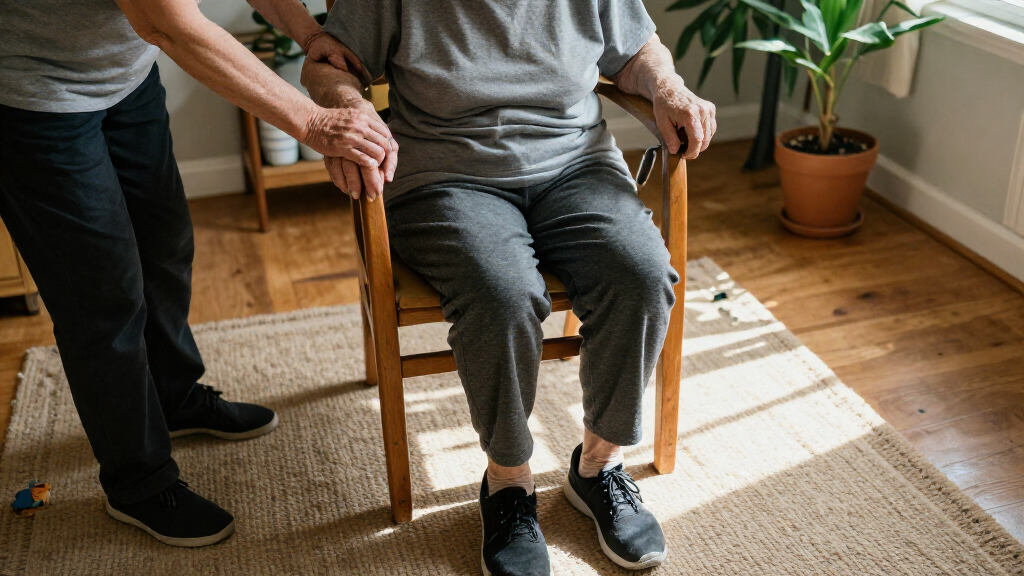
They propose that clinical assessment retain measures such as grip strength and walking speed, while also examining how quickly a person rises from a chair, balance during sustained effort, hand dexterity and walking while talking. The paper also recommends reviewing medications that may blunt motor drive, including sedatives and anticholinergic drugs. These are proposals, not a newly validated screening standard.
A Wider View of Mobility Loss
The proposed shift matters because difficulty walking, rising from a chair or carrying groceries can threaten an older person’s independence and safety. If weakness reflects changes across the motor system as well as muscle loss, a muscle-focused assessment may not capture why a particular person is struggling or which intervention could help.
The report describes falls as a major consequence of poor muscle health and cites Australian data: 253,800 fall-related hospitalizations in 2024–25, and 6,722 deaths following a fall in the preceding year. It also cites an estimated A$5.4 billion in health-system costs from fall injuries. The figures underline the public-health stakes, but they do not establish that the proposed motor-system approach would reduce falls.
The authors argue that research and care should measure everyday function, not only changes in muscle size. That could encourage trials of approaches combining strength training, medication review and other interventions aimed at movement and motor control. Whether such a model leads to better outcomes remains untested.
Products Worth Considering

Bowflex SelectTech 840 Adjustable Kettlebell

Withings Sleep Under-Mattress Sleep Tracking Pad

BowFlex Results Series SelectTech 552 Adjustable Dumbbell
As an affiliate, we earn on qualifying purchases.
How Sarcopenia Is Assessed
The report notes that diagnostic thinking has already moved beyond muscle mass alone. Grip strength, gait speed and chair stands are used because they can reflect function and are linked with outcomes such as falls, disability and death. The authors say, however, that the explanation for sarcopenia has remained centered on muscle despite this broader set of measures.
Earlier in 2026, the Australian Journal of General Practice published a proposed algorithm to guide primary-care screening, assessment and management of poor muscle health, according to the Medical Xpress report. The new paper, by Lucas B. R. Orssatto and colleagues, sets out a five-point agenda for international groups that develop diagnostic criteria. It calls for more work on practical motor-system tests and for clinical trials that assess nerve-related as well as muscle-related outcomes.
“Nobody has yet shown that these measures beat existing screens, either on outcomes or on cost.”
— The paper’s authors
Tests Still Need Validation
The paper presents a proposed framework, not evidence that motor-system screening or treatment produces better outcomes than current practice. The authors say the suggested measures have not been shown to outperform existing screens on health outcomes or cost, and that access to neuromuscular expertise varies across primary care.
The report does not identify which specific tests should become standard, how clinicians should interpret them, or whether the proposed approach would reduce falls, disability or health costs. It also does not establish that medication changes or any single intervention will restore mobility. Those questions require testing in practical clinical settings and trials.
Research Must Test the Proposal
The authors call for investment in practical, validated tests that clinicians can use, guidelines that support a staged assessment and trials measuring both nerve and muscle function. International working groups that set sarcopenia criteria are the intended audience for the paper’s five-point agenda.
The next step is to compare the proposed measures with current screening and determine whether they improve decisions, outcomes or costs. Until those results are available, the motor-system framing is a research and clinical proposal rather than a replacement diagnostic standard.
Key Questions
What do the authors mean by the aging motor system?
They mean the systems involved in producing movement, including the brain, spinal cord, nerves and muscles, along with the connections between them.
Does the paper say muscle loss is irrelevant?
No. The authors do not dismiss muscle loss. They argue it explains only part of age-related weakness and that other motor-system changes should also be considered.
Are the proposed assessment measures already established standards?
No. Measures such as chair-rise speed, dexterity and walking while talking are proposed for closer assessment, but have not been shown to outperform existing screens on outcomes or cost.
What evidence is needed next?
The authors call for validation of practical tests and clinical trials that assess nerve as well as muscle function, including whether the approach improves mobility-related outcomes.
Source: rss