TL;DR

Get health and wellness essentials delivered free — and shop member deals
- Fast, free delivery on millions of items
- Access to Prime Big Deal Days deals on October 6–7
- Prime Video, Amazon Music and more included
Fit&Well reported a five-minute morning Tai Chi routine shared by teacher Brian Thompson, founder of bnew4life. It includes self-massage, arm movements, gentle weight shifts and a standing sequence; the benefits described are Thompson’s claims, not results established by the report.
Tai Chi teacher Brian Thompson shared a five-minute morning routine made up of four movements, according to Fit&Well. The sequence includes self-massage, controlled arm movements, weight shifts and breathing. Thompson says the routine may help release tension and support a calm, focused start to the day.
The practice begins seated, either on a chair or at the edge of a bed. Participants massage the neck, arms, midsection and legs, then cup their hands and pat gently along the shoulders, arms, chest, torso and legs. Fit&Well’s instructions call for an upright posture and soft wrists so the tapping remains gentle.
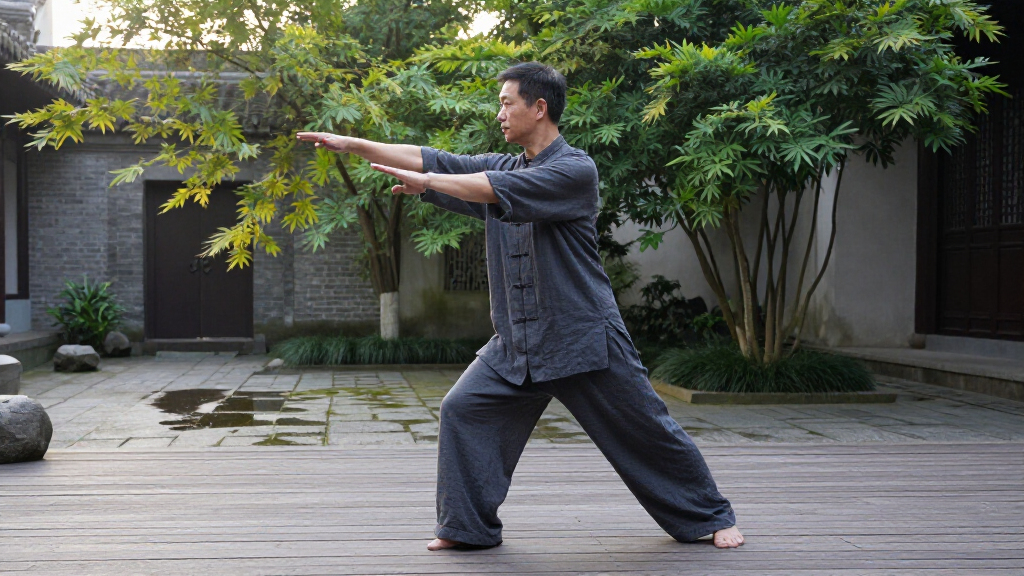
The second movement, called “lifting water,” is done standing with feet about shoulder-width apart and knees slightly bent. The practitioner raises relaxed arms to shoulder height while breathing in, then lowers them with soft elbows while breathing out through the nose. The source suggests three to five repetitions and advises keeping the feet and knees aligned.
Next comes a slow, alternating sequence of turns and weight shifts. One hand moves across the body as the practitioner shifts weight between legs, then the sides are switched. The routine ends with “gather and release”: arms rise overhead with palms up, then lower to waist height with palms turned down. Fit&Well suggests three to five repetitions and smooth, unhurried movement throughout.
A Short Practice for the Start of the Day
The routine is presented as a sequence that can be done at home with little equipment. Its movements include seated and standing portions and proceed from self-massage to coordinated breathing, weight shifts and an arm sequence.
Thompson says the practice may help people feel less stiff and mentally rushed. These are his descriptions of potential benefits; the Fit&Well report does not cite a clinical study measuring this particular five-minute routine or establish that it improves focus for everyone.
Thompson recommends the routine for the morning and describes it as a way to begin the day with slower movement and breathing. Fit&Well provides the steps but does not report how many people have used the sequence or measure changes after practice.
Thompson’s Morning Tai Chi Sequence
Fit&Well describes Tai Chi as a mindful movement practice built around slow, intentional exercises. The report identifies Thompson as a Tai Chi teacher and founder of bnew4life. It presents the routine as his personal go-to practice for mornings, rather than as an official standard or a program tested in the article.
The four parts progress from a seated warm-up to standing movement. In the “lifting water” step, the hands rise on an inhale and lower on a longer exhale. The middle sequence asks practitioners to coordinate a waist turn, a hand movement and a change in weight. The closing movement raises and lowers both arms. Across the steps, the instructions emphasize soft joints, relaxed shoulders and a steady pace.
Thompson’s breathing cues are also part of the routine: the report recommends breathing through the nose during the standing movements, with inhalation and exhalation linked to the direction of the arms or hand. Fit&Well advises readers not to rush the practice. It gives a five-minute duration but does not specify exact timing for each movement.
““It works to gently release deep-seated joint stiffness, muscle tightness, and mental stress.””
— Brian Thompson, Tai Chi teacher and founder of bnew4life, as quoted by Fit&Well
Evidence and Individual Results
The report does not provide a study, participant data or outcome measurements for this exact routine. It also does not quantify how much tension or stiffness the movements might relieve, or how long any effect could last. Statements about feeling more focused, happier or more grounded are attributed to Thompson’s account of the practice and should not be read as guaranteed results.
Fit&Well does not say whether the five-minute estimate includes setup, whether each movement has a fixed duration, or whether the sequence has been adapted for people with limited mobility or health conditions. The routine’s published instructions encourage gentle movement, but they do not explain how to modify every step for individual needs.
How the Practice Is Meant to Progress
The sequence can be followed in the order published: begin seated with self-massage and gentle cupped-hand pats, stand for lifting water, practice the alternating turns and weight shifts on one side before switching, then finish with gather and release. The report recommends moving slowly and using the stated repetitions where provided.
Fit&Well does not announce a follow-up study, additional routine or schedule for future updates. The article provides Thompson’s steps and explanation; the source does not measure whether the practice changes an individual’s stiffness, breathing or focus.
Key Questions
How long is the morning Tai Chi routine?
Fit&Well presents it as a five-minute practice. It does not give a timed breakdown for each of the four parts.
What movements are included?
The routine includes self-massage and gentle tapping, lifting and lowering the arms, alternating hand movements with weight shifts, and a final sequence that raises and lowers the arms.
What benefits does Thompson describe?
Thompson says the practice may help with joint stiffness, muscle tightness, stress and focus. The report does not provide measurements or study results for this specific routine.
Does the routine require equipment?
The published steps describe using a chair or the edge of a bed for the opening and then standing. They do not list any special equipment.
Source: rss
Fall Picks
fall essentials
As an affiliate, we earn on qualifying purchases.