
TL;DR
Children’s Hospital Los Angeles has offered the Inspire hypoglossal nerve stimulation device to eligible adolescents with Down syndrome since July 2025. The implant may provide an alternative for teens whose sleep apnea has not improved after tonsil and adenoid surgery and who cannot use CPAP, but eligibility requires FDA criteria and testing.
Children’s Hospital Los Angeles has offered the Inspire hypoglossal nerve stimulation device to eligible adolescents with Down syndrome since July 2025, providing another treatment option for obstructive sleep apnea when tonsil and adenoid surgery has not helped and CPAP is not tolerated. The implanted device stimulates a nerve that moves the tongue forward during sleep, helping keep the airway open.

Get health and wellness essentials delivered free with Prime
- Fast, free delivery on millions of items
- Prime Video, Amazon Music and more included
- Member-only deals all year
CHLA otolaryngologist Debra Don and pulmonologist Sally Ward work together to assess patients and provide the treatment. According to the hospital’s description, the U.S. Food and Drug Administration has approved the device for adolescents with Down syndrome who are at least 13, meet the device’s weight requirements, have not improved after adenotonsillectomy, cannot tolerate CPAP, and can undergo the required sleep endoscopy and sleep studies.
Implantation takes about three hours. A generator is placed in the chest and connected to an electrode around the hypoglossal nerve in the neck. Patients usually go home the next day, but the device is not switched on immediately: clinicians activate it about six weeks after surgery and use sleep studies to adjust the stimulation.
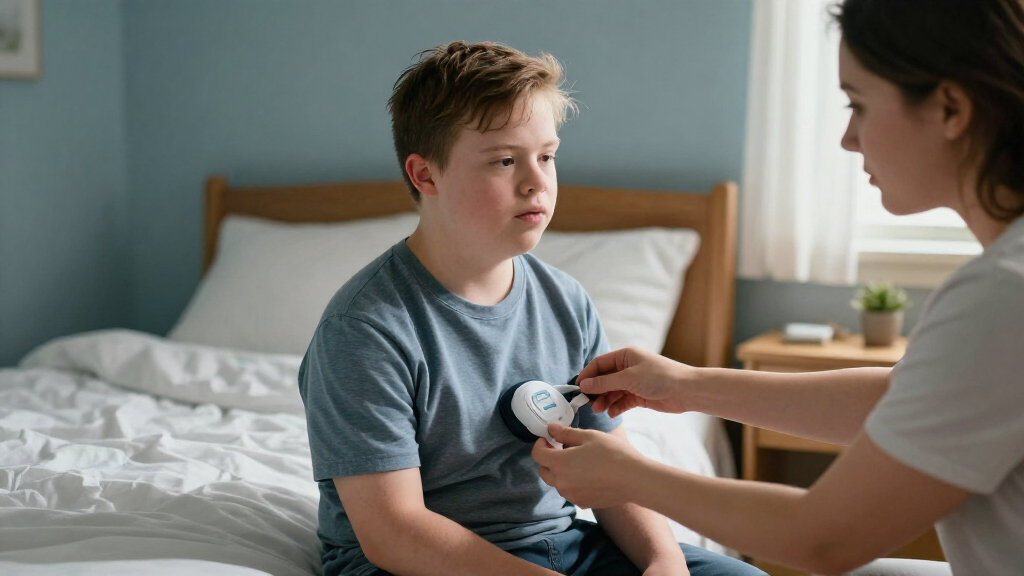
At night, a parent or caregiver uses a remote to turn the device on, and the system responds to the teen’s breathing by stimulating the nerve. The stimulation moves the tongue forward and helps open the airway. CHLA says the signal can be adjusted to build gradually as the teen falls asleep, paused for 15 minutes if needed, and set to switch off after 10 hours. The battery is expected to last 10 to 11 years, after which replacement requires another operation.
An Option When CPAP Is Not Tolerated
The treatment addresses a gap for some adolescents who continue to have obstructive sleep apnea after surgery or cannot use CPAP consistently. Ward told News-Medical that roughly half of people with Down syndrome have difficulty tolerating the mask or using CPAP regularly. The implant is not presented as a replacement for those treatments for everyone; it is an option for patients who meet specific clinical criteria.
Ward told the report that the device can reduce sleep-related breathing events by 50% to 70%. That is a clinician’s reported estimate, not a guarantee for an individual patient. The report does not provide study results, patient numbers, or a comparison group for that figure. Don said the children who received implants at CHLA had positive experiences, but the article does not give details about how many patients were treated or how outcomes were measured.
Sleep apnea can affect daytime functioning as well as breathing at night. Ward said untreated apnea in children with Down syndrome can be associated with fatigue, concentration difficulties and behavioral challenges, and cited potential long-term health risks. The availability of another treatment may matter to families weighing options, while decisions still depend on each adolescent’s evaluation and ability to complete the required testing and follow-up.
Products Worth Considering

Therabody TheraFace Cordless LED Light Therapy Mask

Withings BPM Vision Blood Pressure Monitor

Withings BPM Connect Wi-Fi and Bluetooth Blood Pressure Monitor
As an affiliate, we earn on qualifying purchases.
Why Sleep Apnea Can Persist
The report says an estimated 50% to 80% of children with Down syndrome have sleep apnea. It attributes increased risk to factors including a smaller airway, reduced muscle tone and a relatively large tongue that can obstruct breathing during sleep. The estimate is presented by Ward; the report does not specify the underlying study or time period.
Adenotonsillectomy, removal of the tonsils and adenoids, can help some children, but it does not resolve the problem for everyone. CPAP supports breathing by delivering air through a mask during sleep, though the report says some people with Down syndrome have trouble tolerating the mask or using it consistently. Inspire works differently: rather than using a mask, it stimulates the hypoglossal nerve to move the tongue and help maintain an open airway.
CHLA’s program combines pulmonology and otolaryngology, with sleep studies and endoscopy forming part of the eligibility and treatment process. Don and Ward said the coordination between specialties is important, and Ward said the team also works with the device company to answer families’ technical questions.
“Between 50% and 80% of children with Down syndrome have sleep apnea.”
— Sally Ward, CHLA pulmonologist, as quoted by News-Medical
Patient Outcomes and Access Remain Unclear
The report does not state how many adolescents have received the implant at CHLA, provide patient-level outcomes, or describe any complications. It also does not identify the evidence behind Ward’s estimate that breathing-related events can fall by 50% to 70%, so the result should not be read as a guaranteed reduction for every teen.
Details about the device’s weight thresholds, insurance coverage, cost, and availability at hospitals beyond CHLA are not included. The article also does not explain how clinicians assess long-term effectiveness or what care is needed if the device does not adequately control a patient’s apnea. Eligibility and suitability therefore require an individual clinical evaluation; the report is not a substitute for medical advice.
Referrals and Individual Evaluation
CHLA’s team says it accepts referrals for sleep apnea evaluations for patients with Down syndrome at different points in their care. For adolescents who may qualify, the next steps described by the hospital include specialist assessment, sleep testing and endoscopy, followed by discussion of the implant’s risks, requirements and expected follow-up.
After implantation, clinicians use additional sleep studies to adjust the stimulation level, while families use the remote to activate and pause the device at home. The source report does not announce a new trial, a broader rollout, or a timetable for expansion. Whether access grows beyond the hospital’s current program—and what outcomes its patients experience over time—remains to be seen.
Key Questions
What is the Inspire device?
It is an implanted system that senses breathing during sleep and stimulates the hypoglossal nerve, which moves the tongue forward to help keep the airway open.
Which adolescents with Down syndrome may qualify?
The report says FDA approval covers adolescents who are 13 or older, meet the device’s weight requirements, have not improved after adenotonsillectomy, cannot tolerate CPAP, and can complete required sleep endoscopy and sleep studies. A clinician must determine whether an individual patient qualifies.
How soon does the device start working after surgery?
CHLA says the implant is usually activated about six weeks after surgery. Sleep studies help clinicians set the stimulation level.
Does the device eliminate sleep apnea?
The report does not say that it eliminates the condition. Ward said it can reduce breathing-related events by 50% to 70%; individual results may vary, and the report does not provide the study details behind that estimate.
How long does the battery last?
CHLA says the battery lasts about 10 to 11 years. Replacing it requires a surgical procedure involving one small incision.
Source: rss